
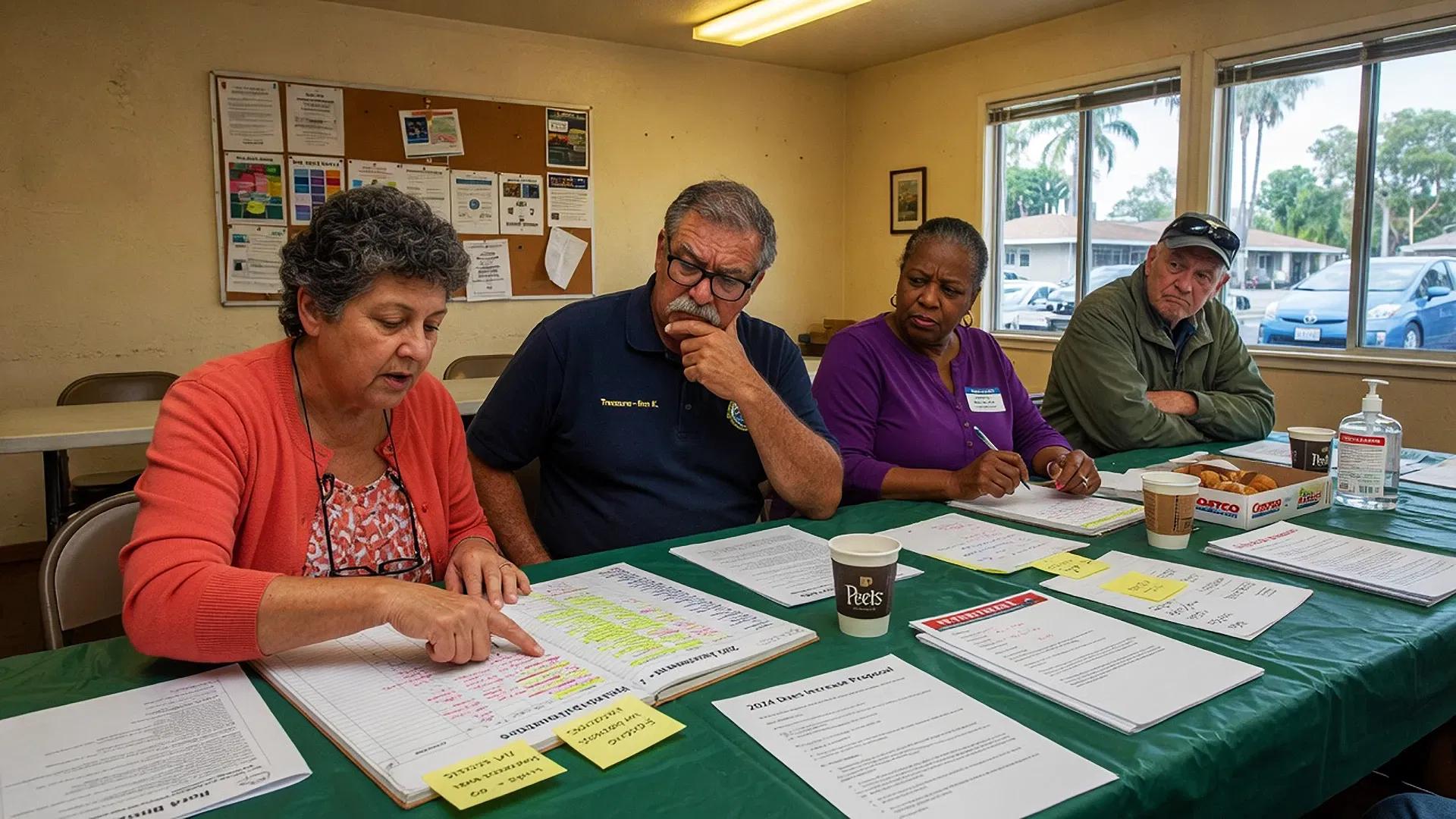
Delinquent assessments are one of the hardest issues an HOA board has to handle. The money is necessary for insurance, maintenance, utilities, reserves, management, repairs, and compliance. But the person behind the delinquent account is also a neighbor, a future meeting attendee, and often a long-term part of the community.
For East Bay associations, the challenge is even more delicate. Communities in Oakland, San Leandro, Alameda, Hayward, Berkeley, Castro Valley, Fremont, Walnut Creek, Concord, and surrounding areas face high operating costs, rising insurance expenses, aging buildings, complex maintenance needs, and a wide range of owner circumstances. Boards need to recover what the association is owed, but they also need to preserve trust.
The goal is not simply to collect. The goal is to collect fairly, consistently, legally, and professionally—without turning a financial problem into a community-wide conflict.
With more than 35 years of East Bay association management experience, SLPM Association Management Services helps homeowner, business, and mixed-use associations approach delinquent assessment recovery with structure, documentation, clear communication, and California-compliant procedures.
Why Delinquent Assessments Create So Much Tension
Assessments are not optional dues. In California common interest developments, regular and special assessments are legal obligations of the owner. When assessments go unpaid, the burden does not disappear. It shifts to the rest of the community through delayed maintenance, strained reserves, reduced cash flow, or higher future assessments.
At the same time, aggressive collection practices can damage the board’s credibility. Owners may become fearful, defensive, embarrassed, or angry. Other residents may hear partial stories and assume the board is being unfair. A single collection matter can become a community relations issue if the process is inconsistent, unclear, or unnecessarily harsh.
The best boards take a balanced approach. They protect the association’s finances while giving owners clear information, reasonable opportunities to communicate, and access to California’s dispute resolution procedures.
The California Legal Framework Boards Need to Understand
California law sets detailed requirements for assessment collection. Boards should work with association counsel on legal interpretation, but every board should understand the basic structure before taking action.
Key California collection rules include:
- Regular and special assessments generally become delinquent 15 days after they are due, unless the governing documents provide a longer period.
- Associations may recover certain reasonable collection costs, attorney’s fees, late charges, and interest within statutory limits.
- Before recording a lien, the association must send a pre-lien notice by certified mail at least 30 days in advance.
- The pre-lien notice must include an itemized statement of charges and information about the owner’s rights.
- Owners may request to meet with the board to discuss a payment plan.
- Before recording a lien, the association must offer internal dispute resolution through the required “meet and confer” process.
- Foreclosure is limited by California law and is not available for every delinquency.
- Before foreclosure, additional dispute resolution and board approval requirements apply.
These requirements matter because assessment recovery is not only a financial function. It is a governance function. Boards that skip steps, fail to document decisions, or use inconsistent procedures may expose the association to unnecessary legal and community risk.
A Trust-Preserving Assessment Collection Strategy
A good collection process should feel firm, predictable, and professional—not personal. The following step-by-step approach helps associations recover delinquent assessments while minimizing conflict.
Step 1: Start With Accurate Records
Before any notice is sent, the account ledger should be reviewed for accuracy. Confirm the owner name, property address, mailing address, assessment amount, due dates, late charges, interest, payments received, and any prior correspondence.
This is one of the most important trust-building steps. Nothing damages credibility faster than sending a collection notice with the wrong amount, wrong address, or missing payment history.
- Confirm the current owner of record.
- Review the account ledger line by line.
- Check whether payments were misapplied or delayed.
- Confirm whether the owner has already disputed the charge.
- Document the review before escalation.
Step 2: Communicate Early in Plain Language
The first communication should be clear, respectful, and easy to understand. Avoid legal threats at the beginning of the process when a simple reminder may resolve the issue.
An effective early notice should explain:
- The amount currently past due.
- The assessment period involved.
- How the owner can pay.
- Who to contact with questions.
- That the association wants to resolve the matter before it escalates.
The tone should be direct but not accusatory. A delinquent owner may be dealing with an automatic payment failure, a job loss, a family emergency, a banking issue, or a misunderstanding about responsibility after a property sale.
Step 3: Keep the Board Out of Personal Arguments
Board members should avoid hallway conversations, social media arguments, or informal side agreements about delinquent accounts. Collection matters should be handled through the association’s approved process.
This protects everyone. The owner receives consistent information. The board avoids selective treatment. The association maintains a defensible record. The community sees that the process is professional rather than personal.
Step 4: Use Payment Plans Before the Situation Becomes Severe
Payment plans are one of the most effective tools for preserving community trust. California law gives owners the right to request a meeting with the board to discuss a payment plan after receiving a delinquency notice. A practical payment plan can help the owner catch up while keeping money flowing into the association.
A good payment plan should be written, specific, and realistic. It should include:
- The total amount owed as of the agreement date.
- The regular monthly assessment amount.
- The additional monthly catch-up payment.
- The payment due dates.
- The length of the plan.
- What happens if the owner misses a payment.
- Whether new assessments are included during the plan period.
- Confirmation that the owner must stay current on future assessments.
Boards should avoid payment plans that look compassionate on paper but are impossible for the owner to satisfy. A short, unrealistic plan often fails quickly and creates more frustration. A reasonable plan with clear deadlines is usually better for both the owner and the association.
Step 5: Send Required Notices Before Recording a Lien
If voluntary reminders and payment discussions do not resolve the delinquency, the association may need to escalate. In California, at least 30 days before recording a lien, the association must send the owner of record a written notice by certified mail. This pre-lien notice must include required information, including an itemized statement of the charges owed and information about the owner’s rights.
This is not the time for shortcuts. The pre-lien notice is a major legal checkpoint. It should be reviewed carefully and handled according to the association’s governing documents, California law, and counsel-approved collection policy.
Step 6: Offer Internal Dispute Resolution
Before recording a lien, the association must offer the owner internal dispute resolution, often called IDR or “meet and confer.” IDR gives the owner and association a structured opportunity to discuss the issue before it becomes more expensive and adversarial.
Used correctly, IDR can be a trust-preserving tool. It allows the owner to explain the situation, correct possible errors, ask for a payment plan, or raise concerns before the association takes a more serious step.
Step 7: Record a Lien Only When the Process Supports It
A lien should not feel like an emotional reaction. It should be the result of a documented process: accurate accounting, proper notice, opportunity to communicate, board awareness, and legal compliance.
Once recorded, the notice of delinquent assessment becomes a serious matter. California law requires that a copy of the recorded notice be mailed by certified mail to every person whose name appears as an owner in the association’s records, no later than 10 calendar days after recordation.
Step 8: Treat Foreclosure as a Last Resort
Foreclosure is the most severe collection remedy and should be approached with extreme care. California law limits when foreclosure may be used for delinquent assessments. In general, an association may not use judicial or nonjudicial foreclosure for delinquent regular or special assessments under $1,800, excluding accelerated assessments, late charges, fees, collection costs, attorney’s fees, and interest, unless the assessments are more than 12 months delinquent.
Before initiating foreclosure, the association must offer the owner dispute resolution or alternative dispute resolution. The board itself must approve foreclosure by majority vote in executive session, and that decision may not be delegated to a manager, attorney, or collection agent.
Community trust principle: Just because a remedy is legally available does not always mean it is the best first choice. Boards should consider proportionality, payment history, owner communication, legal requirements, and the association’s financial exposure before escalating.
How Mediation and ADR Can Preserve Relationships
Alternative dispute resolution, or ADR, can include mediation, arbitration, conciliation, or another nonjudicial process involving a neutral party. In the assessment context, mediation is often the most practical option because it gives both sides a structured setting to resolve the issue without turning the dispute into a public battle.
Mediation can be especially helpful when:
- The owner disputes the amount owed.
- The owner believes payments were misapplied.
- The owner is willing to pay but needs more time.
- The board wants to avoid litigation costs.
- The dispute involves both assessments and a broader owner complaint.
- The relationship between the owner and board has become strained.
California Courts notes that many counties have mediation or dispute resolution programs that may provide free or low-cost mediation before or after a court case is opened. For associations, this can be a practical way to resolve lower-dollar disputes before fees and emotions escalate.
Practical Mediation Tips for HOA Boards
- Bring a clean ledger. The mediator and owner should be able to see the balance, charges, payments, and dates clearly.
- Separate the money issue from personality conflicts. The question is how to resolve the account, not whether people like each other.
- Arrive with settlement authority. A mediation session is less productive if no one has authority to approve a payment plan or compromise within board-approved limits.
- Focus on future compliance. A good resolution should address both the past-due balance and how the owner will stay current moving forward.
- Put any agreement in writing. A handshake understanding is not enough for a collection matter.
- Preserve confidentiality. The community does not need details about an owner’s finances or personal circumstances.
When Small Claims Court May Be More Appropriate Than Foreclosure
For certain assessment debts, small claims court may be a more proportionate tool than foreclosure. California law specifically recognizes small claims as one available path when an association cannot or should not foreclose on a delinquent assessment lien. California Courts describes small claims as a lower-cost, faster process for disputes involving money, with limits that differ depending on whether the claimant is an individual or a business/entity.
Small claims may be worth discussing with association counsel when:
- The delinquency is relatively modest.
- The association wants a judgment rather than immediate lien foreclosure.
- The owner is no longer in possession but still owes assessments.
- The board wants to avoid the community impact of foreclosure.
- The matter is straightforward and well documented.
Boards should confirm current jurisdictional limits, representation rules, and filing procedures before choosing this path.
Communication Principles That Protect Community Trust
The legal process is only part of successful assessment recovery. The communication process matters just as much.
1. Be Consistent
Inconsistent collection practices create resentment. If one owner receives repeated informal extensions while another receives immediate escalation, the board may appear unfair even if the underlying facts differ.
A written collection policy helps the board apply the same process to every account while still allowing legally appropriate discretion.
2. Keep Delinquencies Confidential
Delinquent accounts should not be discussed casually with neighbors, vendors, or other owners. Board discussions involving delinquent accounts should be handled in the appropriate setting, and minutes should avoid unnecessary personal information.
3. Use Plain English
Owners should be able to understand what they owe, why they owe it, what happens next, and how they can resolve the matter. Legal language may be required in certain notices, but cover communications can still be clear and respectful.
4. Avoid Shame-Based Collection
Shame does not improve cash flow. It creates anger, avoidance, and distrust. The association should communicate the seriousness of delinquency without humiliating the owner.
5. Explain the Community Impact
Many owners respond better when they understand that assessments pay for shared obligations: insurance, utilities, landscaping, building maintenance, fire systems, reserves, and common-area repairs. The message should be simple: unpaid assessments affect the whole community.
An East Bay Collection Timeline Boards Can Use
Every association should follow its governing documents, adopted collection policy, and legal counsel’s advice. The following general timeline shows how a trust-preserving process can work.
Confirm the due date, grace period, and payment posting process. Make sure the owner has access to payment instructions and account information.
Send a clear reminder with the amount due, payment options, and contact information. Keep the tone professional and non-accusatory.
Review the account for accuracy. Invite the owner to communicate if there is a payment issue, ownership change, dispute, or hardship.
If the account remains unresolved, send the required pre-lien notice by certified mail at least 30 days before recording a lien. Include the required itemization and owner rights information.
Offer internal dispute resolution and respond appropriately to any written request for a board meeting or payment plan.
If legally appropriate and approved under the association’s process, record the notice of delinquent assessment and send the required copy after recordation.
Evaluate small claims, continued payment plan efforts, ADR, or other legal remedies. Treat foreclosure as a serious last-resort remedy requiring board approval and strict compliance.
Common Mistakes That Damage Trust
Associations often create unnecessary conflict when they skip communication basics or escalate too quickly.
Avoid these collection mistakes:
- Sending unclear ledgers that owners cannot understand.
- Allowing board members to personally argue with delinquent owners.
- Discussing delinquent accounts in front of other homeowners.
- Failing to offer required dispute resolution.
- Ignoring an owner’s written request for a payment plan meeting.
- Using foreclosure language too early in the process.
- Applying late fees or interest inconsistently.
- Failing to release or correct a lien after payment or error.
- Letting collection agents communicate in a way that reflects poorly on the association.
- Failing to review the association’s annual collection policy and disclosures.
How Professional Management Helps
Assessment recovery requires a combination of accounting accuracy, owner communication, legal process management, board coordination, and documentation. Volunteer boards should not have to carry that burden alone.
SLPM Association Management Services helps East Bay associations maintain organized owner ledgers, send timely communications, coordinate with association counsel, support board decision-making, track payment plans, document collection steps, and preserve the professionalism that community trust depends on.
For homeowner, business, and mixed-use associations, professional management can also help boards identify patterns before they become serious. If delinquencies are rising, the issue may point to confusing owner communication, unrealistic budgets, special assessment fatigue, payment portal issues, or broader economic pressure within the community.
Final Checklist: Collect Firmly Without Breaking Trust
- Review the ledger before sending notices.
- Use respectful, plain-language communication.
- Apply the collection policy consistently.
- Keep delinquent account details confidential.
- Offer payment plan discussions when appropriate.
- Follow California pre-lien notice requirements.
- Offer required internal dispute resolution before recording a lien.
- Consider mediation or ADR before positions harden.
- Use small claims court when it is more proportional than foreclosure.
- Treat foreclosure as a last resort requiring strict legal compliance.
- Document every step.
- Work with association counsel before advanced collection action.
Protect Your Association’s Finances and Its Sense of Community
Delinquent assessments cannot be ignored. But they can be handled in a way that is organized, legally compliant, and respectful of the people who live and invest in the community.
SLPM Association Management Services helps East Bay HOAs, business associations, and mixed-use communities manage assessment recovery with clear accounting, consistent procedures, payment plan coordination, board support, and practical local experience.
If your board is struggling with delinquent assessments, inconsistent collection practices, or owner disputes, SLPM Association Management Services can help your association create a better process.
Request an Association Management ProposalLegal note: This article is for general educational purposes only and is not legal advice. Assessment collection requirements can vary depending on the association’s governing documents, account history, board actions, and current law. Boards should consult qualified California association counsel before recording liens, pursuing foreclosure, or taking legal action.
Sources
- California Legislative Information, Civil Code Section 5650 — Assessment Payment and Delinquency: https://leginfo.legislature.ca.gov/faces/codes_displaySection.xhtml?lawCode=CIV§ionNum=5650.
- California Legislative Information, Civil Code Section 5655 — Application of Payments and Receipts: https://leginfo.legislature.ca.gov/faces/codes_displaySection.xhtml?lawCode=CIV§ionNum=5655.
- California Legislative Information, Civil Code Section 5660 — Pre-Lien Notice Requirements: https://leginfo.legislature.ca.gov/faces/codes_displaySection.xhtml?lawCode=CIV§ionNum=5660.
- California Legislative Information, Civil Code Section 5665 — Payment Plan Meeting: https://leginfo.legislature.ca.gov/faces/codes_displaySection.xhtml?lawCode=CIV§ionNum=5665.
- California Legislative Information, Civil Code Section 5670 — Internal Dispute Resolution Before Recording a Lien: https://leginfo.legislature.ca.gov/faces/codes_displaySection.xhtml?lawCode=CIV§ionNum=5670.
- California Legislative Information, Civil Code Section 5675 — Notice of Delinquent Assessment: https://leginfo.legislature.ca.gov/faces/codes_displaySection.xhtml?lawCode=CIV§ionNum=5675.
- California Legislative Information, Civil Code Section 5685 — Lien Release or Correction After Payment or Error: https://leginfo.legislature.ca.gov/faces/codes_displaySection.xhtml?lawCode=CIV§ionNum=5685.
- California Legislative Information, Civil Code Section 5705 — Foreclosure Decision and Dispute Resolution Requirements: https://leginfo.legislature.ca.gov/faces/codes_displaySection.xhtml?lawCode=CIV§ionNum=5705.
- California Legislative Information, Civil Code Section 5720 — Foreclosure Limitations and Small Claims Option: https://leginfo.legislature.ca.gov/faces/codes_displaySection.xhtml?lawCode=CIV§ionNum=5720.
- California Legislative Information, Civil Code Section 5730 — Annual Assessment and Foreclosure Notice: https://leginfo.legislature.ca.gov/faces/codes_displaySection.xhtml?lawCode=CIV§ionNum=5730.
- California Legislative Information, Civil Code Section 5910 — Fair, Reasonable, and Expeditious Internal Dispute Resolution Procedure: https://leginfo.legislature.ca.gov/faces/codes_displaySection.xhtml?lawCode=CIV§ionNum=5910.
- California Legislative Information, Civil Code Section 5925 — Alternative Dispute Resolution Definitions: https://leginfo.legislature.ca.gov/faces/codes_displaySection.xhtml?lawCode=CIV§ionNum=5925.
- California Legislative Information, Civil Code Section 5930 — ADR Prerequisite to Certain Enforcement Actions: https://leginfo.legislature.ca.gov/faces/codes_displaySection.xhtml?lawCode=CIV§ionNum=5930.
- California Courts Self-Help Guide — Small Claims in California: https://selfhelp.courts.ca.gov/small-claims-california
- California Courts Self-Help Guide — Why Mediate in Small Claims: https://www.selfhelp.courts.ca.gov/small-claims/ask-for-money/mediation
- SLPM Association Management Services — Oakland and East Bay Association Management: https://slpmhoa.com/