
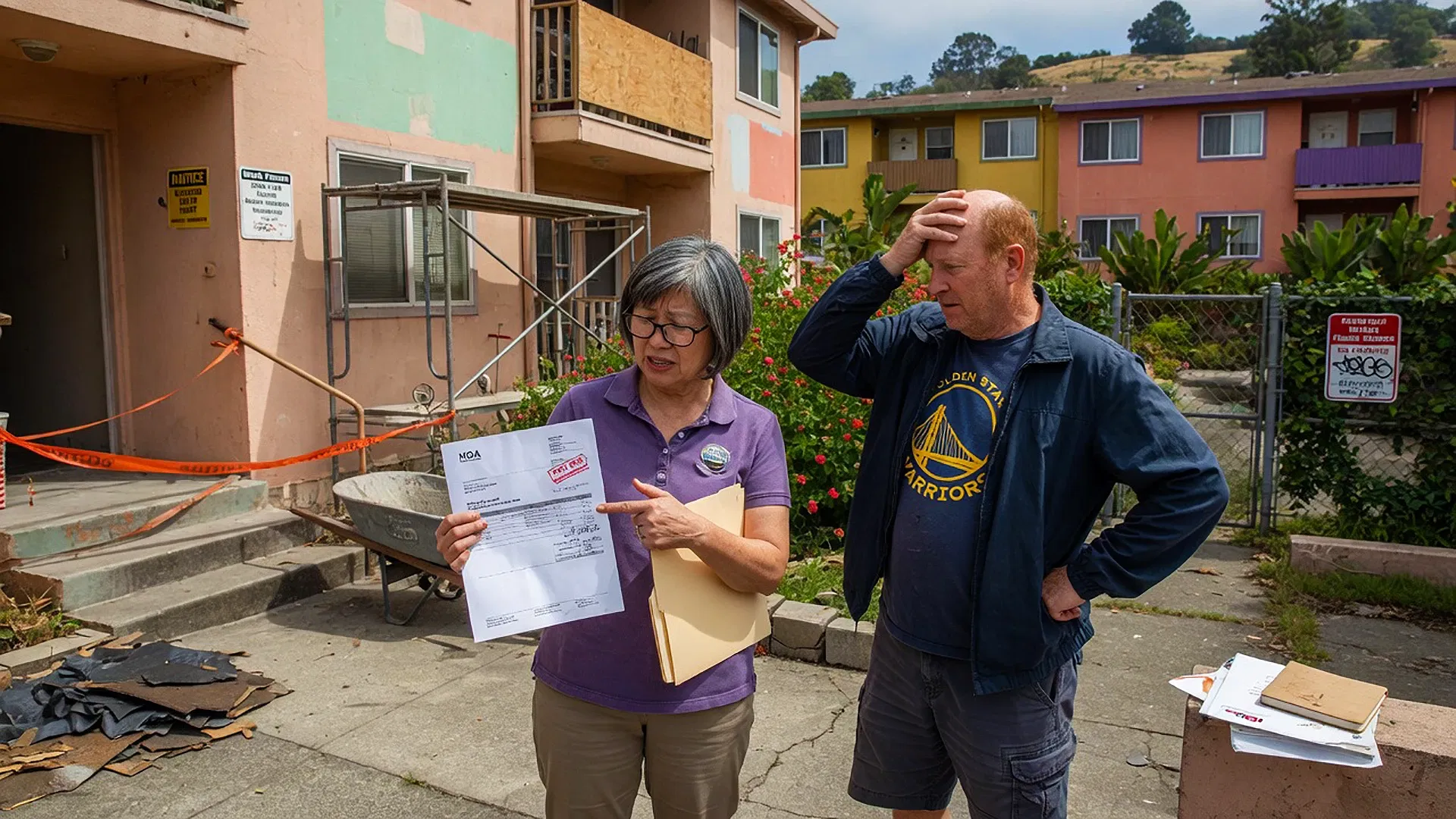
Self-Managing Saved Us Money… Until It Cost Us Everything — The Hidden Toll on Northern California Boards
Self-management sounds practical at first. A few capable volunteers. A shared spreadsheet. A local handyman. A board treasurer who knows accounting. A president who answers emails quickly. No monthly management fee. No outside company. No problem.
Until the roof leak becomes an insurance dispute. Until the unlicensed vendor disappears. Until a records request is missed. Until the election process is challenged. Until a delinquent assessment turns into a lien mistake. Until the board president burns out, resigns, and takes half the association’s institutional knowledge with them.
For Northern California HOAs, business associations, and mixed-use communities, the true cost of self-management is rarely visible in the first budget. It shows up later—in legal bills, emergency repairs, owner distrust, vendor overcharges, board turnover, deferred maintenance, and avoidable lawsuits.
The false economy of DIY management is simple: the association may save a management fee, but the board quietly absorbs the labor, risk, stress, compliance burden, and operational complexity that professional management is designed to handle.
SLPM Association Management Services helps East Bay and Northern California communities move from volunteer overload to organized, accountable management systems that protect the association’s money, records, vendors, maintenance obligations, and board sanity.
Why Self-Management Feels So Tempting
Self-management usually starts with good intentions. Boards want to reduce assessments, avoid unnecessary expenses, and stay close to the community. In smaller associations, business parks, or townhome communities, owners may believe the work is manageable because “not much happens here.”
In reality, association management is not one job. It is many jobs layered together.
A self-managed board may be trying to handle:
- Budget preparation and monthly financial review.
- Reserve planning and capital project coordination.
- Vendor bidding, contracts, insurance, and scheduling.
- Owner notices, meeting agendas, minutes, and open forum rules.
- Annual disclosures and budget reports.
- Assessment collection, payment plans, pre-lien notices, and delinquency tracking.
- Record inspection requests.
- Board elections and secret-ballot procedures.
- Architectural applications and rule enforcement.
- Insurance renewals and claims documentation.
- Emergency response after storms, fires, leaks, outages, or earthquakes.
- Owner complaints, neighbor disputes, and communication blowups.
That is a lot to ask of volunteers who also have jobs, families, businesses, health issues, travel schedules, and lives outside the association.
The Legal Weight Boards Carry Even When They Self-Manage
Self-management does not reduce a board’s legal obligations. A board still has duties under the governing documents, California law, and the standards that apply to nonprofit mutual benefit corporation directors.
California Corporations Code Section 7231 requires directors to perform their duties in good faith, in a manner they believe to be in the best interests of the corporation, and with the care, including reasonable inquiry, that an ordinarily prudent person in a similar position would use under similar circumstances.
California common interest development law also creates specific operational duties. Depending on the association and the issue, boards may need to handle annual budget reports, monthly financial reviews, reserve studies, records inspection rights, meeting notices, open board meetings, secret-ballot elections, assessment collection procedures, insurance requirements, and more.
Self-management does not mean simplified governance. It means the board is responsible for coordinating the same governance requirements without the operational support of a professional management team.
Fictionalized Composite Case Studies: What Can Go Wrong
The following case studies are fictionalized composites based on common patterns seen in self-managed associations. They are not descriptions of specific communities. They are designed to show how small gaps can become expensive problems when boards are left to manage complex association responsibilities alone.
The “Cheap Roofer” That Became a Six-Figure Problem
A small East Bay townhome association had managed itself for years. The roof was aging, but owners resisted increasing assessments. A board member knew someone who could “do roof work for less,” and the board approved repairs without a formal bid package, contractor license verification, detailed scope, or insurance review.
The board believed it had saved thousands by avoiding professional project coordination and choosing the lowest informal quote.
The patch failed during a winter storm. Water entered multiple units. Owners demanded reimbursement. The board struggled to determine whether the damage was owner responsibility, association responsibility, contractor negligence, or an insurance claim.
The association eventually paid more in emergency repairs, water mitigation, legal review, insurance coordination, and owner conflict than it would have spent on a properly scoped project.
What the board learned too late:
- Low bids can become expensive when scope, license status, insurance, warranties, and responsibility are unclear.
- Major components should be tied to reserve planning, not handled as one-off emergencies.
- Contractor selection should be documented and defensible.
- Boards need a process for emergency authorization and insurance documentation.
The Treasurer Who Became the Whole Accounting Department
A self-managed condominium board relied on a volunteer treasurer who was organized, responsive, and trusted by everyone. For years, the system seemed to work. The treasurer collected assessments, paid bills, prepared spreadsheets, and answered owner questions.
Owners praised the board for keeping expenses low. The treasurer was seen as the reason the association did not need professional management.
The treasurer moved out of state. The next board discovered incomplete reconciliations, missing backup documents, inconsistent assessment records, outdated owner contact information, and no clean handoff process.
Nothing appeared fraudulent. The problem was dependency. One volunteer had become the operating system for the entire association.
What the board learned too late:
- Volunteer competence is not the same as institutional control.
- Financial records must be organized so future boards can understand them.
- Monthly financial review is a board responsibility, not just a treasurer task.
- Bank statements, reconciliations, budgets, ledgers, and invoices need a repeatable review process.
The Records Request That Turned Into a Lawsuit Threat
A homeowner in a self-managed association asked to inspect financial records, vendor invoices, and meeting minutes after a special assessment was announced. The board viewed the request as hostile and delayed responding while it tried to figure out what documents had to be provided.
The board thought the owner was trying to stir up trouble and assumed the issue would fade if no one engaged.
The owner escalated the matter, accused the board of hiding financial information, and began rallying neighbors against the special assessment. What started as a document request became a credibility crisis.
The board eventually had to reconstruct records, consult counsel, and respond under pressure. By then, the owner’s distrust had spread.
What the board learned too late:
- Records requests should be treated as compliance events, not personal attacks.
- Association records should be organized before owners request them.
- Clear document retention and response procedures protect the board.
- Transparency problems can turn financial decisions into political battles.
The Election Nobody Knew How to Run
A self-managed board needed to hold an annual election. The directors assumed the process would be simple: ask for volunteers, collect ballots, count votes at the meeting, and announce the winners.
The board believed the community was too small for formal election procedures to matter.
A losing candidate challenged the process, claiming the ballot timing, inspector process, candidate access, and counting procedure were improper. The board had to redo the election and answer angry owner questions about legitimacy.
The association lost time, trust, and money because no one had built an election calendar or confirmed California secret-ballot requirements before the process began.
What the board learned too late:
- Election procedures are not optional because a community is small.
- Secret-ballot elections require planning, timing, and documentation.
- Independent inspectors of election must be handled correctly.
- A flawed election can undermine every board decision that follows.
The Delinquency That Became a Board Nightmare
A self-managed association had several delinquent owners. The board president sent informal reminders, waived late fees for one neighbor, threatened another with a lien, and allowed a third to pay “whenever possible.” No one maintained a consistent collection calendar.
The board thought flexibility was neighborly and avoided the cost of professional collection support.
Owners accused the board of favoritism. Cash flow tightened. The board struggled to issue proper pre-lien notices and could not clearly explain why different accounts were treated differently.
The board did not set out to be unfair. It simply lacked a consistent, documented collection process.
What the board learned too late:
- Assessment collection needs consistency and documentation.
- Neighborly flexibility can look like favoritism if there is no written process.
- Pre-lien notices and collection escalation must follow California requirements.
- Cash flow problems can quickly affect maintenance, insurance, reserves, and vendor payments.
The Hidden Costs of Self-Management
The management fee is visible. The hidden costs of self-management are easier to miss because they are spread across volunteers, vendors, emergencies, errors, and delayed decisions.
1. The Human Cost
Self-management often depends on one or two highly committed volunteers. At first, those people may enjoy helping. Over time, they become the complaint department, maintenance coordinator, bookkeeper, meeting organizer, records manager, emergency responder, and rule interpreter.
The result is burnout. Good volunteers resign. Future candidates avoid board service. Owners become more demanding because they are used to direct access. The community becomes dependent on unpaid labor that cannot be sustained.
2. The Financial Cost
Self-managed boards may save on management fees but lose money through poor vendor negotiation, missed maintenance, weak collections, insufficient reserves, duplicate repairs, rushed emergency work, and lack of competitive bidding.
The most expensive repair is often the one that should have been planned three years earlier.
3. The Legal Cost
Legal problems often begin as process problems: missed notices, unclear minutes, mishandled elections, improper executive session decisions, incomplete records, inconsistent enforcement, or collection mistakes.
Once an owner hires counsel or files a claim, the money saved by self-management can disappear quickly.
4. The Vendor Cost
Vendors can tell when a board is disorganized. Some may overcharge, underperform, skip documentation, avoid warranty responsibility, or pressure the board into change orders because no one is managing scope carefully.
California boards should be especially careful to verify contractor licensing where required. The Contractors State License Board provides public license lookup tools that allow consumers to check a contractor’s license information.
5. The Trust Cost
When owners cannot get clear answers, they begin to assume the worst. Even honest boards can look suspicious when records are disorganized, communications are delayed, or decisions appear inconsistent.
Community trust is hard to measure, but very expensive to lose.
Self-Management Risk Areas Northern California Boards Should Watch Closely
Northern California communities face a combination of high vendor costs, aging buildings, insurance pressure, wildfire exposure, earthquake risk, storm drainage problems, and complex owner expectations. Self-managed boards should pay close attention to the areas where mistakes tend to become expensive.
High-risk self-management areas include:
- Financial review: Monthly review of reconciliations, statements, budget comparisons, and income/expense reports.
- Reserve planning: Timely reserve studies, annual review, and realistic funding decisions.
- Vendor control: Bidding, license checks, insurance certificates, written scopes, and contract tracking.
- Records access: Organized association records and timely responses to owner inspection requests.
- Meeting compliance: Proper notice, agendas, open forum, minutes, and executive session discipline.
- Elections: Secret-ballot procedures, inspectors, deadlines, candidate access, and ballot counting.
- Collections: Consistent delinquency notices, payment plans, pre-lien requirements, and escalation rules.
- Insurance: Renewal tracking, claims documentation, fidelity bond coverage, and board liability protections.
- Emergencies: After-hours vendor access, board escalation, owner communication, and incident documentation.
- Board transitions: Handoff of records, passwords, contracts, bank access, vendor contacts, and open issues.
The “We Have a Volunteer for That” Problem
Every self-managed association has a version of this sentence:
“We have a volunteer for that.”
The problem is not the volunteer. The problem is relying on a person instead of a system.
A strong association should not collapse because one director sells their unit, gets sick, changes jobs, burns out, or no longer wants to be the community’s unpaid manager.
Boards should ask:
- If our treasurer resigned tomorrow, could another director understand the books?
- If our president moved away, would anyone know the vendor history?
- If an owner requested records, could we produce them on time?
- If a pipe burst at 10 p.m., who would answer and dispatch help?
- If a board election were challenged, could we prove the process was correct?
- If a contractor dispute arose, would we have a signed contract, scope, insurance certificate, and documentation?
If the answer is no, the association is not saving money. It is carrying unmanaged risk.
Why DIY Vendor Management Can Get Expensive Fast
Vendor management is one of the most underestimated parts of association operations. Boards are not just hiring someone to fix a problem. They are protecting association funds, common-area assets, insurance coverage, safety, and future board credibility.
Professional vendor coordination helps define:
- What work is actually being performed.
- Whether the vendor is properly licensed for the work.
- Whether insurance is current and sufficient.
- Whether the association needs multiple bids.
- Who approves change orders.
- What warranty applies.
- How owners will be notified.
- How the work will be documented.
- Whether the project should be funded from operations, reserves, or a special assessment.
Without that structure, a board may approve work based on personality, urgency, price, or owner pressure rather than documented need and proper scope.
When Self-Management Starts to Break Down
Most self-managed communities do not fail all at once. The warning signs appear gradually.
Common warning signs include:
- Board emails go unanswered because everyone is overwhelmed.
- Financial reports are delayed or difficult to understand.
- Only one person knows how to access bank accounts, records, or vendor files.
- Annual disclosures are rushed at the last minute.
- Reserve study updates are postponed.
- Vendors are hired without consistent bids or written scopes.
- Owners complain that enforcement is inconsistent.
- Meetings run long and produce few clear decisions.
- Election timelines are unclear.
- Records are scattered across personal email accounts and home computers.
- Emergency repairs are handled through whoever answers their phone first.
- Good board members resign because the workload is too much.
These are not just administrative annoyances. They are signs that the association’s operating model may no longer fit its risk level.
The Before-and-After of Moving From Self-Managed to Professionally Managed
Moving to professional management is not about replacing the board. The board still governs. The manager supports the board by organizing the work, coordinating vendors, maintaining records, preparing information, tracking deadlines, and helping the association operate consistently.
- Board members answer every owner email personally.
- Records are stored in multiple places.
- Vendors call whichever director they know.
- Financial reports depend on one volunteer.
- Maintenance is reactive.
- Meetings are disorganized or overly long.
- Election planning starts too late.
- Board service feels like a second job.
- Owner communication follows a defined process.
- Records are organized and easier to retrieve.
- Vendor coordination is tracked and documented.
- Financial reports are prepared for board review.
- Maintenance calendars and reserve needs are monitored.
- Board packets and agendas are more structured.
- Election and disclosure timelines are planned earlier.
- Board members can focus on decisions instead of daily administration.
A 60-Day Self-Management Reality Check
Boards considering professional management do not have to decide blindly. A 60-day internal review can reveal whether self-management is truly working.
Locate governing documents, meeting minutes, budgets, bank statements, reserve studies, insurance policies, vendor contracts, owner rosters, assessment ledgers, maintenance logs, and election records.
Confirm who has bank access, who reviews reconciliations, how invoices are approved, how reserve transfers are handled, and whether monthly financial review is documented.
Check current vendor contracts, license status where applicable, certificates of insurance, emergency contacts, pricing, scope of work, and renewal dates.
Review annual budget report timing, election deadlines, reserve study schedule, insurance renewal dates, meeting notice procedures, and owner record request processes.
Ask each director to estimate monthly hours spent on emails, vendors, accounting, meetings, owner complaints, records, maintenance, and emergencies.
Compare the apparent savings of self-management against legal costs, vendor inefficiencies, volunteer time, deferred maintenance, owner conflict, and compliance exposure.
Questions to Ask Before Continuing Self-Management
A board that wants to continue self-management should be able to answer the following questions clearly and confidently.
- Who prepares the annual budget report, and when is it distributed?
- Who reviews monthly operating and reserve account reconciliations?
- When was the last reserve study completed?
- Are reserve components, costs, and useful lives current?
- Where are contracts, insurance policies, minutes, and financial records stored?
- How does the association respond to owner records requests?
- Who verifies contractor licenses and insurance?
- How are bids compared and approved?
- What is the process for after-hours emergencies?
- How are delinquent assessments tracked and escalated?
- How are election deadlines and secret-ballot rules managed?
- What happens if the president, treasurer, or secretary resigns tomorrow?
- How many hours per month are directors spending on management tasks?
- Is the current system sustainable for the next three years?
How Professional Management Helps Reduce Board Risk
Professional management does not eliminate the board’s responsibilities. It helps the board meet them with better systems.
SLPM Association Management Services supports Northern California boards by helping organize meeting preparation, financial reporting, vendor coordination, maintenance tracking, owner communication, assessment administration, records management, disclosure calendars, reserve study coordination, and board follow-through.
For East Bay HOAs, business parks, and mixed-use sites, that support can be especially valuable because local conditions often add complexity: aging buildings, storm damage, wildfire concerns, seismic risk, high vendor pricing, parking pressure, insurance challenges, and owner expectations shaped by the cost of Bay Area property ownership.
The best management relationship does not take control away from the board. It gives the board the structure, information, and follow-through needed to make better decisions.
Final Checklist: When Self-Management Is No Longer Worth the Risk
- Board members are spending excessive personal time on association tasks.
- Financial records depend on one volunteer.
- Meeting notices, minutes, and election timelines are inconsistent.
- Reserve planning is outdated or underfunded.
- Vendors are selected informally without strong documentation.
- Owners are frustrated by slow communication or unclear answers.
- Records are hard to locate when requested.
- Delinquent assessments are handled inconsistently.
- Emergency response depends on whichever board member is available.
- Legal counsel is being used to clean up avoidable process problems.
- Good volunteers no longer want to serve.
- The board is saving money on paper but losing control in practice.
Stop Letting Volunteer Burnout Masquerade as Savings
Self-management can look affordable until the hidden costs become impossible to ignore. Legal mistakes, vendor problems, financial confusion, emergency stress, owner distrust, and board burnout can cost far more than professional support.
SLPM Association Management Services helps Northern California HOAs, business parks, and mixed-use communities move from reactive self-management to organized, accountable association operations.
If your board is tired of carrying the workload alone, SLPM Association Management Services can help your association evaluate a better path forward.
Request an Association Management ProposalLegal note: This article is for general educational purposes only and is not legal advice. Association obligations vary based on governing documents, property type, board actions, contracts, insurance policies, and current law. Boards should consult qualified California association counsel, accounting professionals, insurance professionals, and licensed contractors as appropriate.
Sources
- California Legislative Information, Corporations Code Section 7231 — Director Duties and Standard of Conduct: https://leginfo.legislature.ca.gov/faces/codes_displaySection.xhtml?lawCode=CORP§ionNum=7231.
- California Legislative Information, Civil Code Section 4775 — Association and Owner Maintenance Responsibilities: https://leginfo.legislature.ca.gov/faces/codes_displaySection.xhtml?lawCode=CIV§ionNum=4775.
- California Legislative Information, Civil Code Section 4920 — Board Meeting Notice Requirements: https://leginfo.legislature.ca.gov/faces/codes_displaySection.xhtml?lawCode=CIV§ionNum=4920.
- California Legislative Information, Civil Code Section 4925 — Open Meetings and Open Forum: https://leginfo.legislature.ca.gov/faces/codes_displaySection.xhtml?lawCode=CIV§ionNum=4925.
- California Legislative Information, Civil Code Section 5100 — Elections Requiring Secret Ballot: https://leginfo.legislature.ca.gov/faces/codes_displaySection.xhtml?lawCode=CIV§ionNum=5100.
- California Legislative Information, Civil Code Section 5200 — Association Records: https://leginfo.legislature.ca.gov/faces/codes_displaySection.xhtml?lawCode=CIV§ionNum=5200.
- California Legislative Information, Civil Code Section 5300 — Annual Budget Report: https://leginfo.legislature.ca.gov/faces/codes_displaySection.xhtml?lawCode=CIV§ionNum=5300.
- California Legislative Information, Civil Code Section 5500 — Board Review of Financial Documents: https://leginfo.legislature.ca.gov/faces/codes_displaySection.xhtml?lawCode=CIV§ionNum=5500.
- California Legislative Information, Civil Code Section 5550 — Reserve Study Requirements: https://leginfo.legislature.ca.gov/faces/codes_displaySection.xhtml?lawCode=CIV§ionNum=5550.
- California Legislative Information, Civil Code Section 5660 — Pre-Lien Notice Requirements: https://leginfo.legislature.ca.gov/faces/codes_displaySection.xhtml?lawCode=CIV§ionNum=5660.
- California Legislative Information, Civil Code Section 5800 — Limitation of Volunteer Officer and Director Liability: https://leginfo.legislature.ca.gov/faces/codes_displaySection.xhtml?lawCode=CIV§ionNum=5800.
- California Legislative Information, Civil Code Section 5806 — Fidelity Bond Coverage Requirements: https://leginfo.legislature.ca.gov/faces/codes_displaySection.xhtml?lawCode=CIV§ionNum=5806.
- Contractors State License Board — Check a Contractor License: https://www.cslb.ca.gov/onlineservices/checklicenseII/checklicense.aspx
- Contractors State License Board — About CSLB and Consumer Protection: https://www.cslb.ca.gov/
- California Courts Self-Help Guide — Small Claims in California: https://selfhelp.courts.ca.gov/small-claims-california