
AB 130 Took Away Our Fines: How East Bay Boards Can Respond When the Same 5% of Owners Keep Disrupting the Community
Every board knows the pattern. Most owners follow the rules, pay assessments, respect their neighbors, and want a clean, safe, orderly community. Then there is the chronic 5%: the repeat parking violator, the short-term rental problem, the owner who ignores architectural rules, the tenant whose noise complaints never stop, the resident who leaves trash in common areas, or the household that treats every board notice as optional.
Before AB 130, many boards relied on escalating fines to get attention. A warning might become $100, then $250, then $500, then more for repeated violations. Whether that was always fair is a different question. But as a practical enforcement tool, escalating penalties often made chronic violators think twice.
Now California associations are operating under a very different system. Civil Code Section 5850 caps most monetary penalties for governing document violations at $100 per violation. Late charges and interest cannot be added to monetary penalties. A higher fine may be available only if the violation may result in an adverse health or safety impact on the common area or another member’s property, and the board must make a written finding in an open meeting before imposing that higher penalty.
AB 130 did not make HOAs powerless. But it did make old-school fine schedules much weaker. Boards now need better documentation, better rule drafting, better owner communication, stronger use of IDR and ADR, and a willingness to pursue non-fine remedies when chronic violations threaten community trust.
SLPM Association Management Services helps East Bay HOAs, business parks, and mixed-use communities adapt to this new enforcement environment with practical systems that protect fairness, consistency, and community standards.
What AB 130 Actually Changed
AB 130 amended California’s Davis-Stirling enforcement framework, including Civil Code Sections 5850 and 5855. The changes affect how boards impose fines, discipline members, and handle the process before and after a disciplinary hearing.
In plain English, the new rules mean:
- Most HOA monetary penalties for governing document violations are capped at $100 per violation.
- The fine cannot exceed the lesser of the association’s adopted fine schedule or $100 per violation.
- Late charges or interest cannot be added to monetary penalties.
- Higher penalties may be available for violations that may cause adverse health or safety impacts to the common area or another member’s property.
- Before imposing a higher health or safety related penalty, the board must make a written finding in an open board meeting.
- Before discipline is imposed, the member must receive an opportunity to cure the violation before the hearing.
- If the violation is cured before the hearing, discipline cannot be imposed.
- If curing takes longer than the notice period, the member may avoid discipline by providing a financial commitment to cure.
- If the board and member disagree after the hearing, the member must have the opportunity to request internal dispute resolution.
- The board must provide written notice of its disciplinary decision within 14 days after the action.
That is a major shift. Enforcement can no longer depend primarily on large escalating fines. Boards now need to build cases that are clear, documented, consistent, and connected to real property impacts.
Why East Bay Boards Feel Powerless
The East Bay already has high-pressure association issues: dense parking, shared walls, older buildings, mixed-use conflicts, aging infrastructure, tight budgets, and residents who are paying a lot to live in communities with limited tolerance for chaos.
In San Leandro, Oakland, Alameda, Hayward, Castro Valley, Fremont, Walnut Creek, Concord, and surrounding communities, boards often deal with violations that are not dramatic enough to look like court cases but are serious enough to poison community life.
These include:
- Residents repeatedly parking in guest spaces, fire lanes, or another owner’s assigned space.
- Owners ignoring architectural approval requirements.
- Tenants generating repeated noise complaints.
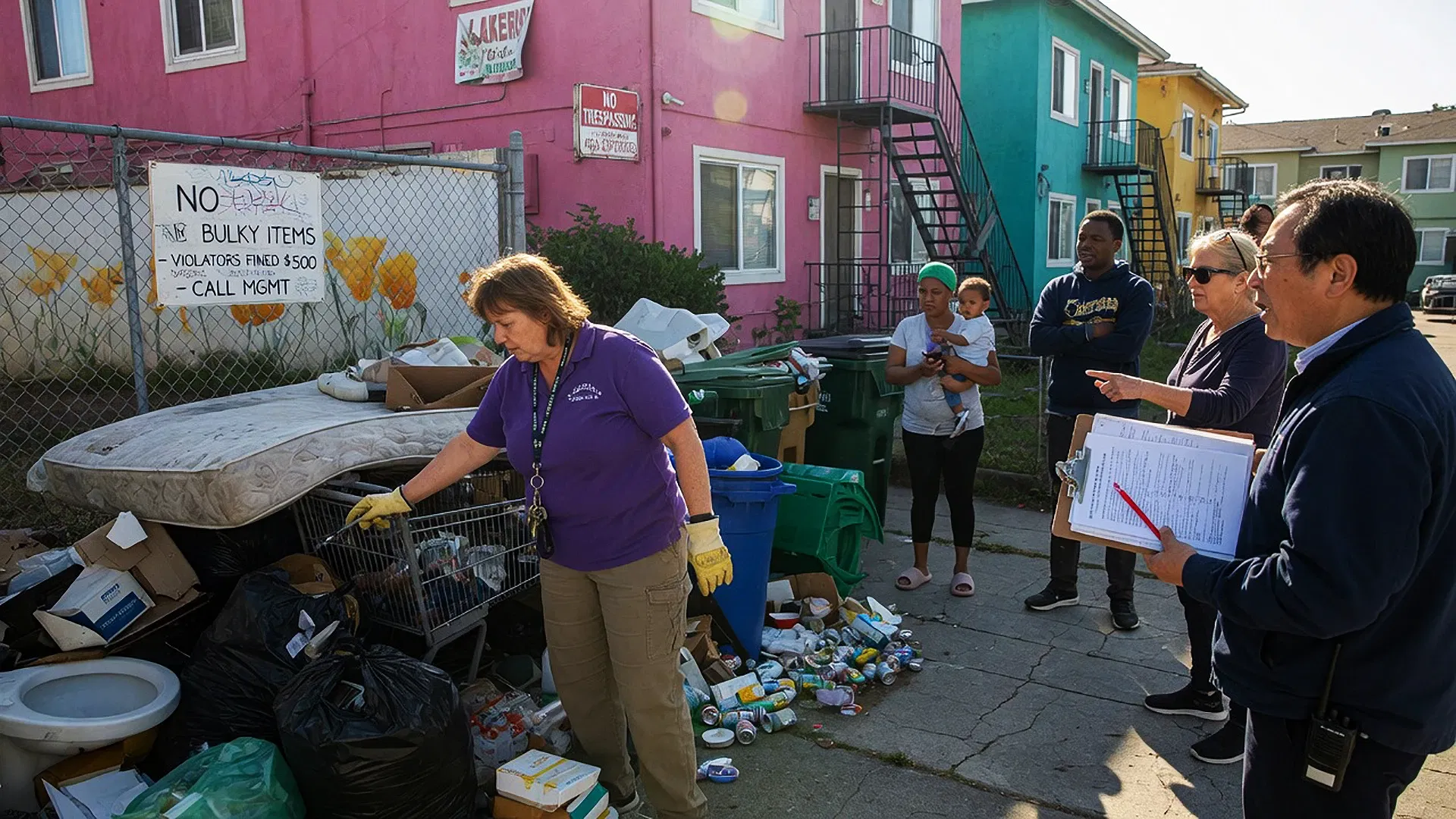
- Trash bins, bulky items, pet waste, or dumping in common areas.
- Unapproved business activity, signage, storage, or commercial use.
- Balcony, patio, or exclusive-use clutter that affects appearance and safety.
- Repeated gate, key fob, access, or security violations.
- Rental rule violations or unauthorized occupancy concerns.
- Unapproved alterations that affect common area, exterior appearance, utilities, or neighboring units.
A $100 cap can feel meaningless when the violation saves the owner money, protects convenience, or supports a profitable activity. If a chronic violator benefits more than $100 by breaking the rule, the fine may become just another cost of doing business.
The resentment problem: rule-following owners become angrier when they see the same violators treat the association’s enforcement process like a weak suggestion.
The Neighbor-From-Hell Problem After AB 130
Most communities are not destroyed by one honest mistake. They are worn down by repeated behavior that everyone can see and nobody seems able to stop.
The board sends a warning. The owner ignores it. The board sends a hearing notice. The owner makes a partial cure, promises to fix it, then repeats the behavior. The board imposes a $100 fine. The behavior continues. Other owners start asking why they should follow rules that appear unenforceable.
Over time, the issue becomes larger than the original violation.
Chronic violations damage communities by creating:
- Anger among rule-following owners.
- Board burnout.
- Meeting hostility.
- Accusations of selective enforcement.
- Pressure to change management companies.
- Demands for recalls or director resignations.
- Higher legal expenses.
- Loss of trust in the association’s ability to govern.
AB 130 does not create the neighbor-from-hell problem. But it forces boards to stop pretending that a bigger fine will always solve it.
Fictionalized Composite Stories: What Chronic Violations Look Like Now
The following scenarios are fictionalized composites based on common enforcement patterns in California associations. They are not descriptions of specific communities, owners, tenants, lawsuits, or disciplinary matters. They are included to show how enforcement problems can escalate when fines are no longer a strong deterrent.
The Owner Who Treats Guest Parking Like a Private Garage
In a small East Bay townhouse community, one owner repeatedly used guest parking for extra household vehicles. Neighbors complained that visitors, caregivers, and delivery drivers had nowhere to park. Before AB 130, the association had escalating fines that eventually made the owner stop.
Escalating fines would eventually become painful enough to change behavior.
A $100 penalty may be less inconvenient than finding offsite parking, especially if enforcement is slow or inconsistent.
The board had to shift from “send another fine” to documented parking audits, clearer signage, consistent notices, possible towing review with counsel, and stronger rule language around repeated misuse.
The Architectural Violation That Became a Community Symbol
A homeowner installed an exterior alteration without approval. The board sent notice. The owner argued that the change improved the property and refused to remove it. Other owners began asking whether they could make their own changes without applying.
A large fine would push the owner to submit an application or reverse the work.
If the owner likes the improvement enough, a limited fine may not matter.
The board’s real enforcement tool became the governing documents themselves: documented architectural review, a demand for compliance, IDR or ADR, and possible legal action for injunctive relief if the violation could not be resolved.
The Noise Complaints That Never Stop
In a condominium building, repeated noise complaints involved late-night parties, loud music, hallway disruption, and tenant behavior. The board had trouble proving each incident, and the owner claimed the complaints were exaggerated.
Repeated hearings and increasing penalties would force the owner to control the tenant.
The board needed better incident logs, witness statements, violation timelines, tenant responsibility notices, and a stronger owner accountability record.
The most effective shift was documentation. The board stopped relying on emotional complaints and began building a clean record of dates, times, witnesses, prior notices, owner responses, and repeated impacts.
The Trash Dumper Who Knows the Fine Is Cheaper Than Disposal
An owner repeatedly left furniture, cardboard, and bulky items near the trash enclosure. The association paid extra hauling charges. Neighbors were furious because the mess made the property look neglected.
Fines would exceed the cost of proper disposal and discourage the behavior.
The association had to focus on evidence, cost reimbursement where legally supported, vendor records, camera policy review, and owner education on disposal procedures.
The board also had to distinguish between a monetary penalty and a charge for damage or costs incurred by the association where authorized and properly noticed. That distinction matters and should be reviewed with counsel.
The Big Mistake: Treating the $100 Cap Like the End of Enforcement
Some owners may assume AB 130 means the association cannot enforce rules anymore. Some boards may feel the same way. Both conclusions are wrong.
California Civil Code Section 5975 still provides that covenants and restrictions in the declaration are enforceable equitable servitudes unless unreasonable, and that governing documents may be enforced by the association against an owner. Civil Code Section 5980 also gives associations standing to participate in litigation, arbitration, mediation, or administrative proceedings in matters involving enforcement of the governing documents and damage to common area.
In other words, the fine may be smaller, but the governing documents still matter.
New enforcement mindset: the fine is no longer the hammer. The board’s tools are process, proof, cure deadlines, IDR, ADR, written agreements, cost recovery where authorized, health and safety findings where appropriate, and legal enforcement when necessary.
Legal Tools That Still Exist After AB 130
Boards still have options. The key is choosing the right tool for the right problem and documenting each step carefully.
1. Better Warning Letters
A weak warning letter says, “You are in violation.” A better warning letter identifies the rule, the date, the conduct, the evidence, the cure requested, the deadline, the hearing process, and the consequences if the issue is not cured.
2. Cure-Focused Enforcement
Because Civil Code Section 5855 now gives members an opportunity to cure before discipline, boards should be specific about what cure means. “Fix the violation” is not enough.
Better examples include:
- Remove the unapproved item from the balcony by a stated date.
- Submit a complete architectural application with drawings and materials.
- Move the vehicle out of guest parking and provide proof of compliance.
- Remove the bulky item and provide the hauling receipt.
- Provide a signed contract or paid deposit for work that takes longer to complete.
3. Health and Safety Findings Where Appropriate
AB 130 allows fines above $100 when the violation may result in an adverse health or safety impact on the common area or another member’s property, but the board must make a written finding in an open board meeting before imposing that higher penalty.
Boards should not stretch this exception casually. Overusing it could create legal risk and owner backlash. But where the facts support it, the board should document the specific health or safety impact, not simply label the violation as serious.
Examples that may need health and safety review: blocked fire access, hazardous storage, unsafe electrical work, water intrusion risks, dangerous animals, dumping that creates pest or sanitation issues, or conduct that damages common area or another member’s property. Boards should consult counsel before using higher penalties.
4. Cost Reimbursement for Damage to Common Area
Civil Code Section 5855 separately addresses monetary charges as reimbursement for costs incurred by the association in repairing damage to common area and facilities caused by a member or the member’s guest or tenant. That is not the same as a punishment fine, but it still requires proper notice and process.
If an owner, tenant, guest, vendor, or invitee causes identifiable common-area damage, boards should preserve photos, invoices, vendor reports, witness statements, and governing document authority before seeking reimbursement.
5. Suspension of Membership Privileges Where Authorized
Some governing documents may authorize suspension of certain privileges after proper notice and hearing. This is not available in every community, and it cannot be used in a way that violates law or governing documents. But in some cases, non-monetary discipline may be more effective than a small fine.
6. IDR and Written Resolutions
Internal dispute resolution is no longer a side issue. It may become one of the most important tools for resolving chronic violations without immediately going to court.
Civil Code Section 5910 requires a fair, reasonable, and expeditious procedure. If the member invokes the process, the association must participate. Written agreements reached through the process can bind the parties and be judicially enforceable if not in conflict with law or the governing documents.
7. ADR and Injunctive Relief
For serious continuing violations, boards may need to consider alternative dispute resolution and, if necessary, court enforcement. Civil Code Section 5930 generally requires parties to try ADR before filing certain superior court enforcement actions for declaratory, injunctive, or writ relief.
Legal action should not be the first move for every violation. But for an owner who refuses to stop a significant ongoing violation, a $100 fine may not be enough. A court order may be the only realistic tool.
8. Rule Updates Under the Operating Rule Process
Some enforcement problems exist because the rules are vague, outdated, or written for a different property reality. Civil Code Section 4360 requires at least 28 days of general notice before most operating rule changes, along with the text of the proposed rule change and a description of its purpose and effect. Boards should use this process to clarify rules before relying on enforcement.
What Boards Should Stop Doing Immediately
AB 130 makes sloppy enforcement more dangerous. Boards should review old habits before they create new problems.
Stop doing these things:
- Using outdated fine schedules that exceed the new statutory cap.
- Adding late fees or interest to unpaid fines.
- Assuming repeated violations can be handled with automatic escalating fines.
- Sending vague notices that do not explain how the owner can cure.
- Failing to document whether a violation was cured before hearing.
- Calling every serious violation a health and safety issue without a factual written finding.
- Letting board members personally argue with chronic violators.
- Using fines when the real goal is removal, repair, compliance, or a court order.
- Ignoring owner requests for IDR after a hearing disagreement.
- Failing to update the annual policy statement and discipline policy.
A Better Enforcement Workflow for the Post-AB 130 Era
Boards need an enforcement workflow that is slower to anger but faster to document. The goal is to build a record that can survive owner scrutiny, legal review, and possible court enforcement if the violation continues.
Identify the exact governing document provision, rule, policy, or architectural requirement. Do not enforce from memory.
Record the date, time, location, photos, witness reports, vendor reports, and prior history. Separate facts from frustration.
Explain what must be done, by when, and what evidence of cure is required. Use plain language.
Before the hearing, determine whether the owner cured the violation or made a financial commitment to cure where applicable.
Provide the required notice, let the owner attend and address the board, and meet in executive session if requested.
If discipline is imposed, send written notice of the board’s decision within 14 days following the action.
If the board and member disagree after the hearing, be prepared for IDR. Use the process to seek a written resolution.
For continuing violations, review ADR, counsel involvement, cost recovery, health and safety findings, or injunctive relief where appropriate.
How to Handle the 5% Without Punishing the 95%
One of the most damaging board mistakes is allowing chronic violators to shape the entire tone of community governance. If the board communicates only through threats, warnings, and enforcement notices, the 95% of rule-following owners may feel like they are living in a police state.
Better enforcement separates chronic cases from ordinary owner communication.
Practical ways to protect the 95%:
- Use private, documented enforcement for individual violations.
- Send neutral community reminders without shaming owners.
- Publish rule summaries that explain the purpose behind the rules.
- Thank owners when community-wide compliance improves.
- Keep confidential matters out of open forum arguments.
- Do not let one violator consume every board meeting.
- Use management and counsel to keep the process calm and consistent.
The Hardest Enforcement Category: Profitable Violations
A $100 fine is least effective when the violation creates financial gain or saves the owner more than the fine amount.
Examples may include:
- Unauthorized rentals or occupancy arrangements.
- Unapproved commercial use of residential space.
- Improper storage that avoids paid storage costs.
- Guest parking misuse that avoids offsite parking costs.
- Unapproved architectural changes that would be expensive to reverse.
- Trash dumping that avoids proper hauling fees.
In these cases, boards should not rely solely on penalties. They should evaluate the actual remedy needed: stop the use, remove the improvement, restore the common area, recover documented costs, mediate a written resolution, or pursue a court order.
Health and Safety Findings: Powerful but Risky
The health and safety exception may be one of the most important parts of the new law, but it must be used carefully.
The statute does not give boards unlimited power to label every nuisance as a health or safety problem. It requires that the violation may result in an adverse health or safety impact on the common area or another member’s property, and the board must make a written finding specifying that impact in an open board meeting.
Before using a higher fine, boards should ask:
- What specific common area or member property is affected?
- What health or safety risk is created?
- Is the risk supported by photos, reports, complaints, vendor findings, or expert input?
- Does the fine schedule or supplement identify the higher penalty?
- Has counsel reviewed the proposed finding and process?
- Will the written finding be made in an open board meeting?
- Has the owner received the required opportunity to cure?
A well-supported finding can help address serious conduct. A weak finding can make the board look like it is trying to evade the $100 cap.
Why Documentation Is Now More Important Than the Fine Amount
In the old enforcement model, boards sometimes treated documentation as secondary because the fine itself did the work. That approach is less effective now.
Post-AB 130, documentation is the foundation for every meaningful remedy. If the case later requires IDR, mediation, counsel, cost recovery, health and safety findings, or court enforcement, the board needs a clean record.
A good violation file should include:
- The governing document provision or rule involved.
- The date and time of each incident.
- Photos, video screenshots, vendor reports, or witness statements where appropriate.
- Prior warnings and owner responses.
- Evidence of whether cure occurred.
- Hearing notice and proof of delivery.
- Hearing outcome and written decision notice.
- IDR or ADR requests and responses.
- Cost invoices if reimbursement is sought.
- Board findings for health or safety issues where applicable.
A 30-Day AB 130 Enforcement Reset
Boards should not wait until a chronic violation becomes a public battle. A 30-day enforcement reset can help the association adapt quickly.
Compare the association’s current monetary penalty schedule against the new $100 cap, late charge prohibition, and health and safety exception requirements.
Rewrite violation notices to specify the cure required, deadline, hearing rights, owner opportunity to attend, and post-hearing IDR opportunity where applicable.
List the top recurring problems: parking, noise, trash, architectural violations, rental issues, access control, pets, storage, or nuisance conduct.
Work with management and counsel to identify non-fine tools for each category: documentation, IDR, ADR, cost reimbursement, rule updates, towing review, written agreements, or legal enforcement.
Creative Legal Workarounds That Are Not Really Workarounds
The phrase “workaround” can sound like boards are trying to evade the law. That is the wrong approach. The better goal is to use the lawful tools that still exist instead of relying only on fines.
Legal enforcement alternatives may include:
- Sharper rule language: update vague rules through the proper operating rule process.
- Better cure standards: define exactly what the owner must do to comply.
- Written IDR agreements: use internal dispute resolution to create enforceable compliance plans.
- ADR before litigation: use mediation or other ADR for repeated violations before court action where required.
- Injunctive relief: seek a court order for serious continuing violations when fines are ineffective.
- Cost reimbursement: recover documented repair or cleanup costs where authorized and properly noticed.
- Health and safety penalties: use higher penalties only where supported by facts and written findings.
- Privilege suspension: consider non-monetary discipline where governing documents authorize it and counsel confirms legality.
- Vendor controls: use towing, trash hauling, security, access control, or cleanup vendors where legally and operationally appropriate.
- Owner education: reduce repeat violations by explaining rules before conflicts escalate.
Common Board Mistakes Under the New Fine Cap
Boards that keep using pre-AB 130 habits may create more legal risk than compliance.
- Leaving outdated fine schedules in the annual policy statement.
- Assuming the $100 cap means the association cannot enforce at all.
- Using health and safety findings without specific facts.
- Failing to give owners a meaningful opportunity to cure.
- Ignoring evidence that a member has financially committed to cure.
- Continuing to issue daily or monthly escalating fines without legal review.
- Failing to distinguish fines from cost reimbursement.
- Moving to legal action without considering IDR or ADR requirements.
- Trying to publicly shame chronic violators.
- Letting anger from rule-following owners drive sloppy enforcement.
How Professional Management Helps After AB 130
Enforcement after AB 130 requires more administration, not less. Boards need better notices, stronger documentation, hearing calendars, cure tracking, owner communication, rule review, IDR coordination, vendor records, and counsel coordination when a violation will not stop.
SLPM Association Management Services helps East Bay associations manage enforcement with the structure needed for the new environment: clear violation logs, organized board packets, owner communications, hearing support, rule tracking, maintenance coordination, vendor documentation, and practical follow-through.
The point is not to punish owners. The point is to preserve livable communities where the majority of owners do not feel abandoned when a small group refuses to follow the rules.
Final Checklist: Enforcement After AB 130
- Update the fine schedule to comply with the $100 cap and late charge restrictions.
- Review the annual policy statement for outdated discipline language.
- Rewrite violation notices to include clear cure instructions.
- Track whether cure occurs before the hearing.
- Document financial commitments to cure when work takes longer.
- Use written decision notices within 14 days after board action.
- Be prepared for IDR if the owner and board disagree after hearing.
- Use health and safety findings carefully and only with facts.
- Separate fines from reimbursement for common-area damage.
- Review recurring violations for rule updates or operational fixes.
- Use ADR and legal remedies when small fines will not stop serious ongoing violations.
- Work with professional management and counsel before enforcement becomes chaos.
Do Not Let a $100 Fine Cap Turn Into Community Chaos
AB 130 changed the enforcement landscape, but it did not eliminate the board’s responsibility to protect the community. Chronic violations still need action. The difference is that boards must now rely less on big fines and more on documentation, cure procedures, IDR, ADR, rule clarity, vendor coordination, and legally sound escalation.
SLPM Association Management Services helps East Bay HOAs, business parks, and mixed-use communities adapt to the new enforcement rules without losing control of community standards.
If your board is struggling with chronic violators, outdated fine schedules, owner resentment, or confusion after AB 130, SLPM Association Management Services can help your association build a better enforcement process.
Request an Association Management ProposalLegal note: This article is for general educational purposes only and is not legal advice. Enforcement authority, fine schedules, health and safety findings, discipline, cure rights, cost reimbursement, privilege suspension, IDR, ADR, and court remedies can vary based on current law, governing documents, evidence, facts, and association-specific procedures. Boards should consult qualified California association counsel before revising enforcement policies, imposing penalties, making health and safety findings, suspending privileges, or pursuing legal action.
Sources
- California Legislative Information, Civil Code Section 5850, Monetary Penalties and Fine Schedule Requirements: https://leginfo.legislature.ca.gov/faces/codes_displaySection.xhtml?lawCode=CIV§ionNum=5850.
- California Legislative Information, Civil Code Section 5855, Discipline Hearings, Cure Rights, IDR Opportunity, and Decision Notice: https://leginfo.legislature.ca.gov/faces/codes_displaySection.xhtml?lawCode=CIV§ionNum=5855.
- California Legislative Information, Civil Code Section 5310, Annual Policy Statement: https://leginfo.legislature.ca.gov/faces/codes_displaySection.xhtml?lawCode=CIV§ionNum=5310.
- California Legislative Information, Civil Code Section 4360, Operating Rule Change Procedure: https://leginfo.legislature.ca.gov/faces/codes_displaySection.xhtml?lawCode=CIV§ionNum=4360.
- California Legislative Information, Civil Code Section 5900, Internal Dispute Resolution Scope: https://leginfo.legislature.ca.gov/faces/codes_displaySection.xhtml?lawCode=CIV§ionNum=5900.
- California Legislative Information, Civil Code Section 5910, Fair, Reasonable, and Expeditious Internal Dispute Resolution Procedure: https://leginfo.legislature.ca.gov/faces/codes_displaySection.xhtml?lawCode=CIV§ionNum=5910.
- California Legislative Information, Civil Code Section 5925, Alternative Dispute Resolution Definitions: https://leginfo.legislature.ca.gov/faces/codes_displaySection.xhtml?lawCode=CIV§ionNum=5925.
- California Legislative Information, Civil Code Section 5930, ADR Before Certain Enforcement Actions: https://leginfo.legislature.ca.gov/faces/codes_displaySection.xhtml?lawCode=CIV§ionNum=5930.
- California Legislative Information, Civil Code Section 5975, Enforcement of Governing Documents: https://leginfo.legislature.ca.gov/faces/codes_displaySection.xhtml?lawCode=CIV§ionNum=5975.
- California Legislative Information, Civil Code Section 5980, Association Standing to Enforce Governing Documents and Common-Area Claims: https://leginfo.legislature.ca.gov/faces/codes_displaySection.xhtml?lawCode=CIV§ionNum=5980.
- CalMatters, New California Law Restricts HOA Fines to $100 Per Violation: https://calmatters.org/politics/2025/10/california-hoas-fines-capped/
- CAI California Legislative Action Committee, AB 130: New Limits on HOA Fines and Enhanced Due Process: https://caiclac.com/ab-130-new-limits-on-hoa-fines-and-enhanced-due-process/