
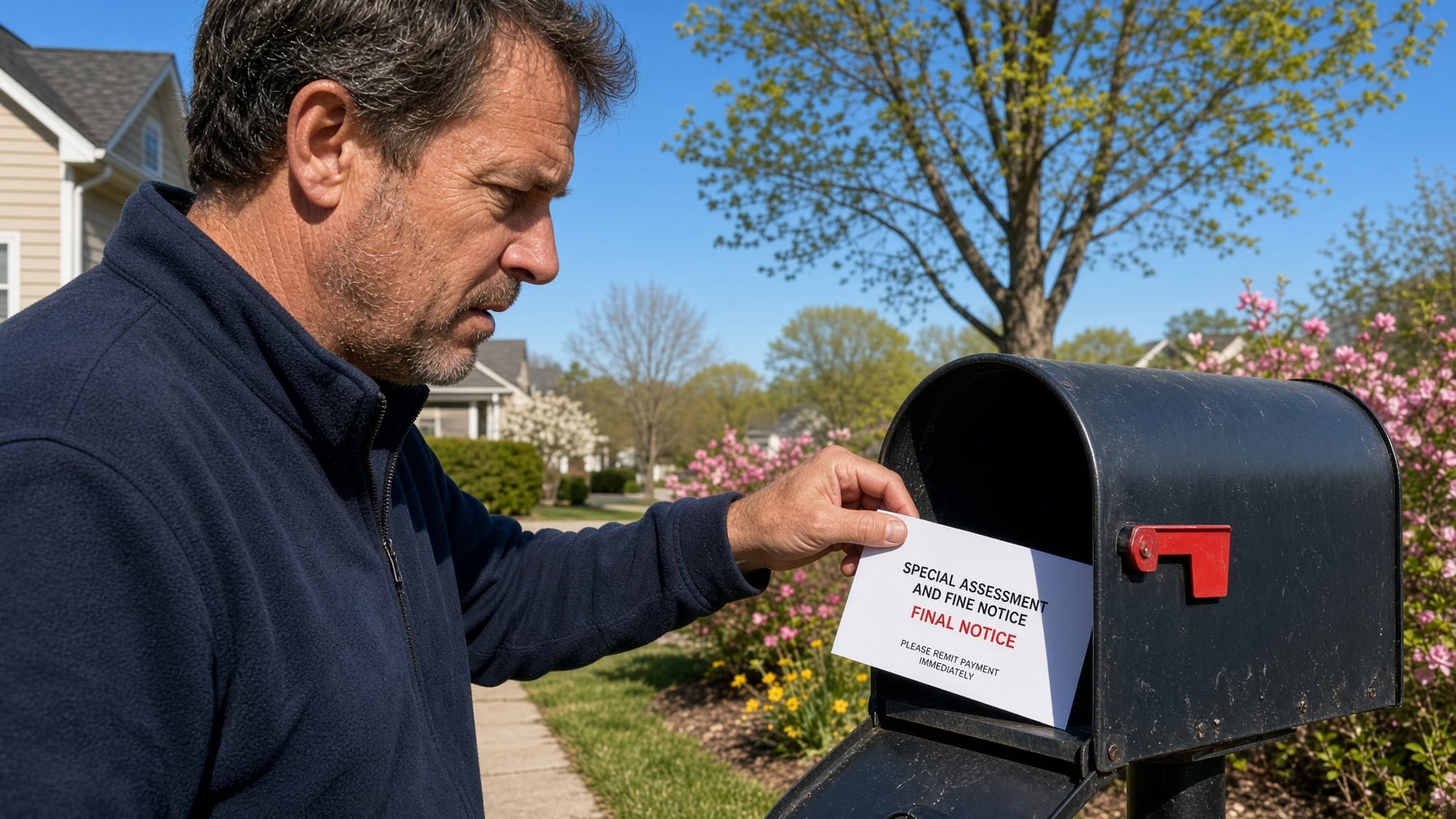
Most East Bay boards still have a penalty schedule that lists $200, $500, or escalating daily fines for the usual violations. AB 130, effective June 30, 2025, amended Civil Code section 5850 so that a monetary penalty may not exceed the lesser of the amount stated in the schedule that was in effect at the time of the violation or $100 per violation. Continuing to send notices that quote the old higher amounts creates an immediate due-process problem. Owners who receive those notices now have a straightforward ground to challenge both the amount and the process. The health-and-safety exception exists, but it requires a written finding made in an open meeting before the higher amount is imposed. Boards that treat the old schedule as still controlling are generating easy challenges they did not need to create.
Section 5850 still requires the board to adopt and distribute a schedule of monetary penalties in the annual policy statement. The statute now places a hard ceiling over that schedule. An association whose schedule lists $50 for a parking violation may charge only $50. An association whose schedule lists $400 for the same violation may charge only $100. The phrase “the lesser of” is doing the work. The only route above $100 is subdivision (d): the violation must be one that may result in an adverse health or safety impact on the common area or another member’s property, and the board must make a written finding specifying that impact in a board meeting open to the members before imposing the higher amount. Late charges and interest on any monetary penalty are prohibited under subdivision (e). The schedule must still be provided to any member on request under subdivision (f).
Why the Old Schedule Creates the Challenge
When a board sends a hearing notice that quotes a fine of $250 or $500 from a schedule adopted before June 30, 2025, the notice itself states an amount the statute no longer permits for an ordinary violation. The owner who appears at the hearing, or who does not appear, can later argue that the association failed to follow its own governing documents and the current statute. The challenge is simple: the schedule that was distributed listed a higher amount, the notice quoted that higher amount, and section 5850(c) limited the penalty to $100. Courts and arbitrators do not need a long factual record to decide that the amount charged exceeded the statutory ceiling. Associations that continue to use the old language in their violation letters are handing owners a clean argument that the discipline was not properly authorized.
The same problem appears when the board attempts to impose daily fines or escalating amounts that were common in older schedules. The statute limits the penalty to $100 per violation. Boards that treat each day as a new violation without documenting a separate occurrence and without providing the required notice for each are creating additional process defects. East Bay associations that have updated their schedules and their letter templates to state “the lesser of the amount listed or $100” have removed the most obvious ground for challenge. Associations that have not updated either document continue to generate notices that invite the challenge. Coordinated compliance support that reviews the current schedule against section 5850 and revises the standard hearing notice removes the defect before the next violation letter goes out.
The Health-and-Safety Exception Requires a Specific Finding
Subdivision (d) allows a penalty greater than $100 only when the violation may result in an adverse health or safety impact and the board makes a written finding specifying that impact in an open meeting before the penalty is imposed. The finding cannot be supplied after the fact, and it cannot be made in executive session. The schedule itself must already contain the higher amount. A board that wants to fine more than $100 for an unsecured dog that has bitten someone, or for a structural alteration that creates a fall hazard, must first state in open session the specific adverse impact and then impose the higher amount that appears in the schedule. Associations that attempt to use the exception without the written finding have simply charged more than the statute allows. The owner who challenges the amount can point to the absence of the finding in the minutes of an open meeting.
The exception is narrow. Most parking, architectural, pet, and noise violations do not qualify. Boards that treat the exception as a general authority to keep charging the old higher amounts are creating the same due-process problem they would have created by ignoring the cap entirely. Documenting the finding in the open-meeting minutes, and attaching a copy of the finding to the notice of the board’s decision, produces a record that shows the association followed the procedure the statute requires. Associations that skip the finding and simply charge the higher amount leave the record incomplete. Administrative support that prepares the agenda item, drafts the proposed finding, and confirms it appears in the open-session minutes keeps the exception usable when it actually applies and keeps ordinary violations inside the $100 ceiling.
Process Defects That Travel with the Wrong Amount
Section 5855 still requires written notice of a disciplinary hearing at least ten days before the meeting. AB 130 added an opportunity for the member to cure the violation before the meeting. The board may not impose discipline if the member cures before the hearing or, when a cure would take longer than the notice period, if the member provides a financial commitment to cure. The written notice of the board’s decision must now go out within fourteen days after the action. Associations that continue to use pre-June 2025 letter templates often omit the cure language or state an incorrect decision-notice deadline. When those omissions travel with a fine amount that already exceeds the statutory ceiling, the owner has multiple independent grounds to challenge the discipline. Each ground is visible on the face of the documents the association itself sent.
Owners who receive a notice that quotes a $500 fine, does not mention the opportunity to cure, and arrives with a decision letter more than fourteen days later have a straightforward package of defects. Associations that have revised both the schedule and the letter templates so that the amount is stated as the lesser of the schedule or $100, the cure opportunity is described, and the decision-notice deadline is correct have removed those defects. The remaining enforcement work is ordinary: notice, hearing, decision, and collection of an amount the statute permits. East Bay boards that have made those revisions report fewer challenges that turn solely on the amount or the timing. Boards that have not made the revisions continue to spend time responding to challenges that the updated documents would have prevented.
What Boards Can Do with the Next Violation Notice
Boards that still have the old schedule in use can adopt a revised schedule that lists amounts at or below $100 for ordinary violations and that identifies the specific health-or-safety violations for which a higher amount may be charged. They can distribute the revised schedule in the next annual policy statement or by individual delivery under section 4040. They can update the standard hearing notice so that it states the lesser of the schedule amount or $100, describes the opportunity to cure, and references the fourteen-day decision-notice requirement. They can prepare a short template for the written health-or-safety finding so that it can be adopted in open session when the exception actually applies. Each of those steps is ordinary and removes the most common grounds for challenge.
Associations that have already updated the schedule and the letters can confirm that the most recent annual policy statement contains the current schedule and that the standard templates used by the manager or the board secretary reflect the statutory language. SLPM Association Management Services has coordinated enforcement policies, hearing notices, and open-meeting findings for East Bay associations since 1991. If your board is still using a penalty schedule or violation letter that quotes amounts above $100 for ordinary violations, the free proposal process lets you see the documents that need revision and the language that keeps the next notice inside the statutory ceiling.
Request your free association management proposal here. We will review your current penalty schedule, hearing notices, and recent enforcement letters and identify the amounts and process language that create unnecessary challenges under section 5850.