
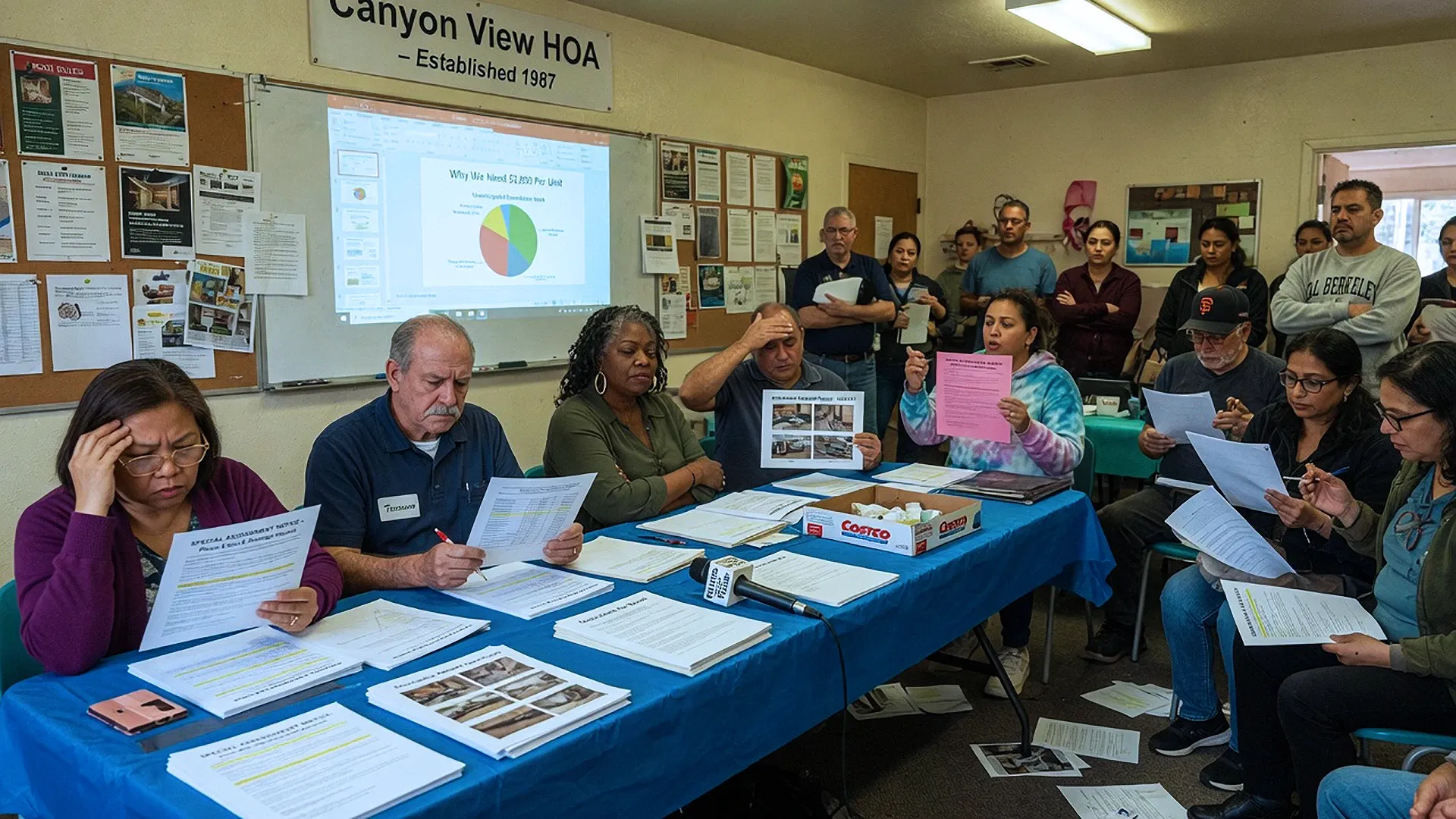
The Special Assessment Hammer Is About to Drop: $5,000 to $40,000 Bills That Can Trigger Recall Elections Across the East Bay
Few words create panic in an HOA faster than “special assessment.” A $5,000 bill can strain a household. A $15,000 bill can destroy trust. A $40,000 bill can turn a quiet community into a recall campaign almost overnight.
Across older East Bay communities, the pressure is building. Roofs are aging. Decks and balconies need inspections and repairs. Insurance costs are rising. Utility systems are failing. Reserve studies are exposing years of underfunding. Repair mandates are forcing boards to act faster than owners expected.
The result is a brutal board dilemma: approve a painful assessment now, or delay the repair and risk safety issues, legal exposure, insurance problems, emergency costs, and even larger bills later.
The special assessment fight is rarely just about money. It is about trust, transparency, timing, board credibility, owner shock, and whether residents believe the crisis was unavoidable or caused by years of poor planning.
SLPM Association Management Services helps East Bay HOAs, business parks, and mixed-use communities manage these high-stakes financial moments with organized budgeting, reserve study coordination, vendor oversight, owner communication, board support, and practical planning before financial pressure becomes a community revolt.
Why Special Assessments Are Hitting So Hard Right Now
Special assessments happen when an association needs money beyond the regular budget. Sometimes the reason is a true emergency. Sometimes it is the predictable result of years of underfunded reserves. Often, it is both.
In Northern California and the East Bay, boards are dealing with several forces at once:
- Aging roofs, siding, paving, plumbing, electrical systems, decks, balconies, gates, elevators, drainage, and retaining walls.
- Higher contractor pricing and longer lead times.
- Insurance market pressure and larger deductibles.
- Reserve studies that reveal major funding gaps.
- California balcony and elevated exterior element inspection requirements.
- Newer utility service repair obligations for certain common-area gas, heat, water, and electrical interruptions.
- Storm, wildfire, earthquake, and water intrusion risks.
- Owner resistance to regular assessment increases over many years.
When these pressures collide, boards may be forced to ask owners for thousands of dollars with little warning. The board may be acting responsibly, but owners often hear something different: “You failed to plan, and now we have to pay.”
The California Rules Boards Cannot Ignore
California law places limits on special assessments and regular assessment increases. Civil Code Section 5605 generally limits board-imposed special assessments to 5 percent of the association’s budgeted gross expenses for the fiscal year unless the association obtains required member approval.
However, Civil Code Section 5610 creates emergency exceptions. The 5 percent limit does not apply to certain emergency situations, including extraordinary expenses required by a court order, extraordinary expenses necessary to repair or maintain common interest development property where a threat to personal health or safety or another hazardous condition is discovered, and extraordinary expenses that could not have been reasonably foreseen by the board when preparing and distributing the annual budget report.
Board reality: Even when a special assessment is legally available, the community backlash may be severe if owners believe the board failed to explain the problem early, ignored reserve warnings, or rushed the vote without context.
Boards also must pay close attention to reserve planning. Civil Code Section 5550 requires certain associations to conduct a reasonably competent and diligent visual inspection of accessible major components at least once every three years as part of the reserve study process. Civil Code Section 5300 requires the annual budget report to include reserve-related disclosures, and Civil Code Section 5565 requires the reserve summary to include items such as estimated replacement costs, useful lives, reserve fund amounts, and current reserve funding deficiency expressed on a per-unit basis.
These disclosures matter. They are not just paperwork. They are warning lights. When owners see a special assessment after years of optimistic budget messaging, they often ask why the reserve disclosures did not trigger earlier action.
Repair Mandates Are Making the Timeline Worse
Some assessments are no longer easy to defer. Two areas are creating special pressure for older California associations.
Exterior Elevated Elements
California Civil Code Section 5551 requires condominium associations with applicable exterior elevated elements to conduct periodic visual inspections by specified licensed professionals. The first inspection was required by January 1, 2025, with later inspections on a nine-year cycle. For older buildings with balconies, decks, elevated walkways, exterior stairs, or waterproofing failures, inspection findings can quickly turn into major repair demands.
Owners may see the report and ask, “Why are we just learning about this?” Boards may reply, “The inspection just confirmed it.” Both can be true. That does not make the assessment easier to accept.
Common-Area Utility Service Interruptions
SB 900 amended California Civil Code Section 4775, effective January 1, 2025. When interrupted gas, heat, water, or electrical service begins in the common area and the association is responsible for repair, the board must commence the process to make the necessary repairs to restore service within 14 days of the interruption. The law also affected reserve study considerations for gas, water, and electrical service to the extent the association is responsible for those lines.
That means older associations with failing common-area pipes, wiring, water service, gas lines, or electrical systems may face urgent repair obligations at the same time they are discovering the reserves are not enough.
Why $5,000 to $40,000 Bills Create Board Revolts
A special assessment is not just another line item. It arrives at the owner’s kitchen table as a personal financial crisis.
For some households, $5,000 means draining savings. For others, $15,000 means using credit cards, borrowing from family, delaying medical care, or considering a sale. A $40,000 assessment can feel like a second down payment on a property the owner already bought.
Boards often underestimate the emotional response because they are focused on the repair problem. Owners are focused on the personal financial shock.
Owners usually want answers to five questions:
- Why is this happening now?
- Did the board know this was coming?
- Why were reserves not enough?
- Were cheaper options considered?
- Can we trust this board to manage the money?
If the board cannot answer those questions clearly, the conversation can shift from repair funding to board removal.
When Special Assessments Become Recall Campaigns
California law requires elections for removal of directors to be conducted by secret ballot under Civil Code Section 5100. Associations must also follow election operating rules under Civil Code Section 5105. That means a board revolt is not just an angry meeting. If it becomes a formal removal effort, the association enters a regulated election process with timelines, notices, inspectors, ballots, equal-access rules, and procedural requirements.
Recall pressure usually builds when owners believe the board has violated one of four trust principles:
- Transparency: owners feel the board hid or minimized the problem.
- Competence: owners believe the board failed to plan or manage vendors.
- Fairness: owners believe costs were allocated improperly or selectively.
- Voice: owners feel the decision was made before they were heard.
A board can be legally correct and still lose the room. In assessment crises, communication is not a soft skill. It is a survival tool.
Fictionalized Anonymous Stories: Boards That Survived and Boards That Did Not
The following scenarios are fictionalized composites based on common East Bay HOA patterns. They are not descriptions of specific associations, owners, lawsuits, or recall elections. They are included to show how assessment crises can unfold depending on board communication, planning, vendor control, and owner trust.
The $8,500 Roof Assessment That Almost Failed
A mid-sized East Bay townhome association had delayed roof replacement for years. The board had raised dues only slightly because owners were vocal about keeping assessments low. After repeated leaks, the roofer warned that patching was no longer a responsible option. The reserve account covered only part of the project.
Owners were shocked by the $8,500 assessment because past newsletters had described the roof as “being monitored.” They thought monitored meant manageable.
The board held a town hall, shared the reserve study history, explained the leak pattern, presented multiple bids, and showed what further delay would cost.
The assessment passed, but only after the board changed its tone from “trust us” to “here is the evidence.”
Lesson:
Owners may accept painful costs when they can see the history, alternatives, bids, and consequences of delay.
The $22,000 Balcony Repair Bill That Triggered a Recall Effort
A condominium association received an exterior elevated element inspection report identifying serious deck and waterproofing concerns. The board announced a $22,000 per-unit assessment shortly afterward. The repair need was real, but the communication was poor.
Owners received a dense letter with legal language, a payment deadline, and little explanation. Some owners believed the board had known about the issue for years and waited until the inspection deadline forced action.
A group of owners organized a recall petition, argued that the board had failed to fund reserves, and demanded a new vendor review before any contract was signed.
The board eventually survived, but the community lost months to distrust, accusations, and procedural disputes.
Lesson:
A safety-related assessment needs more communication, not less. Owners need to understand inspection findings, repair urgency, funding options, and why the board chose a specific path.
The $5,000 Plumbing Assessment That Became a Fairness Fight
In an older Oakland building, a shared plumbing line failed repeatedly. The board approved a $5,000 special assessment to replace a section of common-area piping. Owners on the unaffected side of the building objected, arguing that they should not pay for repairs benefiting only one stack of units.
The board announced the assessment before explaining common-area responsibility, cost allocation under the governing documents, or the risk that the failure could spread.
The board later brought in counsel and a plumber to explain why the line was common-area infrastructure and why replacement was needed to protect the building.
The assessment collected, but the board spent months repairing trust that could have been preserved with better sequencing.
Lesson:
If owners will ask “why am I paying for that,” answer before the invoice arrives.
The $40,000 Special Assessment That Removed the Board
A small hillside association faced slope, drainage, and retaining wall repairs after years of deferred maintenance. The board had received warnings in prior reports, but past directors resisted funding reserves because owners objected to dues increases.
The current board inherited the problem but communicated as if the assessment were a sudden emergency. Owners found old reports, accused the board of hiding the true history, and organized a recall.
The board was removed. The new board still had to approve the repair and assessment, but now the association also paid for election costs, legal review, transition disruption, and months of delay.
The community changed boards, but it did not change the physics of the hillside or the cost of the repair.
Lesson:
Replacing the board does not erase the repair bill. But poor transparency can make owners believe a different board will make the bill disappear.
The Underfunded Reserve Trap
Underfunded reserves do not always look like a crisis at first. Monthly dues feel lower. Owners are happier in the short term. Boards avoid hard conversations. Projects are pushed out another year.
Then the roof leaks, the balconies fail inspection, the insurance carrier demands repairs, the sewer line backs up, the elevator needs modernization, or the electrical system can no longer support the building.
The problem is that deferred funding does not eliminate cost. It compresses cost.
Reserve truth: A community can pay gradually through realistic monthly assessments, or it can pay suddenly through special assessments, loans, emergency assessments, and crisis pricing. The repair cost is coming either way.
Civil Code Section 5565 requires the reserve summary to include the current estimated replacement cost, estimated remaining life, estimated useful life of each major component, reserve fund cash available, percentage funding, and current deficiency in reserve funding expressed on a per-unit basis. Boards should treat that deficiency number as a warning, not a footnote.
How Boards Accidentally Make the Backlash Worse
Most boards do not create assessment crises on purpose. But they often make owner backlash worse through avoidable mistakes.
Assessment communication mistakes include:
- Announcing the assessment before explaining the repair history.
- Using legal language instead of plain English.
- Failing to show bids, project scope, and reserve data.
- Claiming “there is no choice” without explaining alternatives.
- Ignoring the hardship impact on owners.
- Not explaining whether a member vote is required.
- Confusing emergency assessments with regular special assessments.
- Failing to explain why reserves are insufficient.
- Not showing what delay would cost.
- Allowing rumors to spread before the board provides facts.
In a financial crisis, silence is not neutral. Owners will fill the information gap with suspicion.
How to Announce a Special Assessment Without Losing the Community
The board’s first communication can determine whether owners listen, panic, or organize against the board.
Start With the Problem, Not the Bill
Before stating the amount, explain what failed, who inspected it, what risk exists, and why the association must act.
Show the Timeline
Owners should see when the issue was first identified, what was done, what reports were received, what bids were collected, and when the board made decisions.
Explain the Funding Gap
Show current reserves, projected project cost, available insurance proceeds if any, possible financing, and the remaining amount that must be funded.
Explain the Legal Path
Owners need to know whether the board can impose the assessment, whether member approval is required, whether an emergency exception applies, and how the association will conduct any required vote.
Acknowledge the Financial Pain
Do not pretend a $10,000 bill is routine. Owners need to know the board understands the burden and has considered payment timing, financing, phasing, and hardship communication where legally appropriate.
Provide a Question Channel
Give owners a structured way to submit questions before the meeting. This reduces ambush-style conflict and helps the board prepare clear answers.
A Board Survival Plan for Large Special Assessments
A board facing a major assessment needs more than a motion and a notice. It needs a crisis communication and governance plan.
Review Civil Code requirements, governing documents, budget authority, emergency assessment rules, and whether membership approval is required. Consult association counsel before presenting the final path.
Obtain qualified inspection reports, engineering input where needed, contractor proposals, and scope explanations. Avoid announcing a number before the board understands what is included.
Show current reserves, funding deficiency, project cost, insurance assumptions, financing options, and assessment amount. Owners need to see the math.
Use plain-language FAQs, project summaries, timeline graphics, meeting slides, and written Q&A. Repeat the core facts consistently.
Let owners ask questions, but keep the meeting organized. Separate emotional comments from board decision-making and legal requirements.
Whether the assessment passes, fails, or proceeds as an emergency assessment, send a clear recap with next steps, payment timing, project schedule, and owner resources.
When a Loan Is Better Than One Massive Bill
A special assessment is not the only funding tool. Some associations evaluate bank financing to spread payments over time. Financing can reduce immediate owner shock, but it can also increase total cost through interest, fees, and longer-term budget commitments.
Boards should compare:
- One-time special assessment.
- Installment special assessment.
- Association loan repaid through assessments.
- Emergency assessment, if legally available.
- Project phasing, if safe and practical.
- Insurance proceeds, if applicable.
- Reserve transfers, if allowed and financially responsible.
Civil Code Section 5735 addresses circumstances where an association may assign or pledge assessment rights as collateral for financing. Boards should work with counsel, a CPA, and experienced lenders before committing the association to debt.
Owner trust tip: When presenting a loan option, show both the monthly impact and total repayment cost. Owners deserve to understand the tradeoff between lower immediate pain and higher long-term cost.
How to Handle Owners Who Cannot Pay
Some owners will object because they disagree with the project. Others will object because they simply cannot pay.
Boards should be careful not to treat every objection as bad faith. A fixed-income owner, first-time buyer, retired resident, small business owner, or family already stretched by Bay Area costs may be genuinely terrified by a major bill.
Depending on legal and financial constraints, boards may consider:
- Payment plans.
- Installment schedules.
- Clear delinquency procedures.
- Information about loan or financing options.
- Consistent collection policies.
- Owner education before deadlines.
The association still needs the money to protect the property. But respectful communication can reduce shame, panic, and hostility.
How to Prevent the Next Special Assessment Crisis
Not every special assessment can be avoided. But many assessment crises can be softened or prevented through earlier planning.
Boards should review:
- Whether reserves are being funded according to the current reserve study.
- Whether the reserve study includes all required major components.
- Whether balconies, decks, elevated walkways, and exterior stairs have been inspected where required.
- Whether gas, water, and electrical infrastructure is considered where the association is responsible.
- Whether insurance deductibles and exclusions have changed.
- Whether project costs have been updated for current contractor pricing.
- Whether deferred repairs are being disclosed clearly.
- Whether owners understand that low dues today can mean larger bills later.
- Whether the board has a funding policy for major repairs.
- Whether professional management is helping track deadlines, vendors, reports, budgets, and owner communication.
A 90-Day Assessment Readiness Plan
Boards do not need to wait until a crisis to prepare. A 90-day assessment readiness review can reveal whether the association is heading toward financial shock.
Identify major components, remaining useful lives, funding level, per-unit deficiency, and components with urgent timelines.
Review balcony inspection requirements, utility infrastructure obligations, roof conditions, life-safety systems, drainage, structural issues, and insurance-driven repairs.
Obtain current vendor feedback on major projects. Old reserve estimates may not reflect current East Bay labor, material, insurance, permit, and emergency pricing.
Review regular assessment increases, special assessments, financing, phasing, reserve transfers, and emergency assessment authority where applicable.
Prepare plain-language summaries explaining project needs, reserve gaps, timing, risks of delay, and likely funding paths before asking owners to vote or pay.
Invite owner questions before the bill arrives. Transparency before assessment notices can reduce anger later.
Common Mistakes That Turn Assessment Pain Into Board Removal
- Keeping reserves artificially low to avoid unpopular dues increases.
- Failing to explain reserve deficiencies each year.
- Ignoring repeated maintenance warnings.
- Announcing a large assessment without owner education.
- Using one bid for a major project without explaining why.
- Letting vendors, not the board, control the project narrative.
- Failing to show the cost of delay.
- Not distinguishing between emergency and non-emergency authority.
- Disregarding owner hardship and payment timing concerns.
- Responding defensively to reasonable questions.
- Allowing board members to argue personally with angry owners.
- Failing to follow election procedures if a recall effort begins.
How Professional Management Helps Before the Hammer Drops
Special assessments are governance, finance, vendor, communication, and trust events all at once. Volunteer boards should not have to manage that pressure alone.
SLPM Association Management Services helps East Bay associations prepare for major repair funding decisions by supporting reserve study coordination, budget planning, vendor communication, board packets, owner notices, meeting preparation, project tracking, assessment administration, and follow-up communication.
For older HOAs, business parks, and mixed-use communities, professional management can help boards move from crisis reaction to planned communication. That structure matters when the numbers are large and owners are angry.
The goal is not to make owners like a special assessment. The goal is to help owners understand why it is necessary, how the amount was determined, what alternatives were reviewed, and how the board will manage the money responsibly.
Final Checklist: Surviving a Large Special Assessment
- Confirm legal authority before announcing the assessment path.
- Review governing documents and California assessment limits.
- Confirm whether member approval is required.
- Determine whether an emergency assessment exception applies.
- Gather inspection reports, bids, scopes, and reserve data.
- Explain the repair history in plain English.
- Show current reserves and funding deficiency.
- Present financing and phasing options where realistic.
- Acknowledge owner hardship directly.
- Hold structured owner meetings before rumors take over.
- Document board decisions carefully.
- Follow secret-ballot election rules if owner approval or director removal becomes part of the process.
- Use professional management to support communication, logistics, and follow-through.
Do Not Wait Until Owners Are Holding Recall Petitions
Large special assessments are painful, but the worst damage often comes from poor communication, weak reserve planning, rushed vendor decisions, and owners feeling blindsided.
SLPM Association Management Services helps East Bay HOAs, business parks, and mixed-use communities prepare for major repairs, reserve shortfalls, emergency assessments, owner meetings, and the difficult financial conversations that boards cannot avoid forever.
If your board is worried about underfunded reserves, repair mandates, a major project, or owner backlash over a potential special assessment, SLPM Association Management Services can help your association build a better plan before the hammer drops.
Request an Association Management ProposalLegal note: This article is for general educational purposes only and is not legal advice. Special assessment authority, emergency assessment authority, reserve obligations, board elections, director removals, financing, owner payment plans, and repair responsibilities can vary based on governing documents, current law, budget history, project facts, and association-specific circumstances. Boards should consult qualified California association counsel, reserve professionals, CPAs, insurance professionals, and licensed contractors as appropriate.
Sources
- California Legislative Information, Civil Code Section 5605, Assessment Approval Requirements and Limits: https://leginfo.legislature.ca.gov/faces/codes_displaySection.xhtml?lawCode=CIV§ionNum=5605.
- California Legislative Information, Civil Code Section 5610, Emergency Assessment Situations: https://leginfo.legislature.ca.gov/faces/codes_displaySection.xhtml?lawCode=CIV§ionNum=5610.
- California Legislative Information, Civil Code Section 5735, Assignment or Pledge of Assessment Rights to Financial Institutions: https://leginfo.legislature.ca.gov/faces/codes_displaySection.xhtml?lawCode=CIV§ionNum=5735.
- California Legislative Information, Civil Code Section 5300, Annual Budget Report: https://leginfo.legislature.ca.gov/faces/codes_displaySection.xhtml?lawCode=CIV§ionNum=5300.
- California Legislative Information, Civil Code Section 5550, Reserve Study Requirements: https://leginfo.legislature.ca.gov/faces/codes_displaySection.xhtml?lawCode=CIV§ionNum=5550.
- California Legislative Information, Civil Code Section 5565, Reserve Summary and Funding Deficiency: https://leginfo.legislature.ca.gov/faces/codes_displaySection.xhtml?lawCode=CIV§ionNum=5565.
- California Legislative Information, Civil Code Section 5551, Exterior Elevated Element Inspections: https://leginfo.legislature.ca.gov/faces/codes_displaySection.xhtml?lawCode=CIV§ionNum=5551.
- California Legislative Information, Civil Code Section 4775, Maintenance Responsibilities and Utility Service Interruptions: https://leginfo.legislature.ca.gov/faces/codes_displaySection.xhtml?lawCode=CIV§ionNum=4775.
- LegiScan, California Senate Bill 900, Chapter 288, Statutes of 2024, Common Interest Developments: Repair and Maintenance: https://legiscan.com/CA/text/SB900/id/3021794
- California Legislative Information, Civil Code Section 5100, Elections Requiring Secret Ballot: https://leginfo.legislature.ca.gov/faces/codes_displaySection.xhtml?lawCode=CIV§ionNum=5100.
- California Legislative Information, Civil Code Section 5105, Election Operating Rules: https://leginfo.legislature.ca.gov/faces/codes_displaySection.xhtml?lawCode=CIV§ionNum=5105.
- California Legislative Information, Civil Code Section 5110, Inspectors of Elections: https://leginfo.legislature.ca.gov/faces/codes_displaySection.xhtml?lawCode=CIV§ionNum=5110.
- California Legislative Information, Civil Code Section 5115, Voting Procedures and Ballot Delivery: https://leginfo.legislature.ca.gov/faces/codes_displaySection.xhtml?lawCode=CIV§ionNum=5115.
- California Legislative Information, Civil Code Section 5120, Ballot Counting and Election Results: https://leginfo.legislature.ca.gov/faces/codes_displaySection.xhtml?lawCode=CIV§ionNum=5120.
- Contractors State License Board, Check a Contractor License: https://www.cslb.ca.gov/onlineservices/checklicenseII/checklicense.aspx